
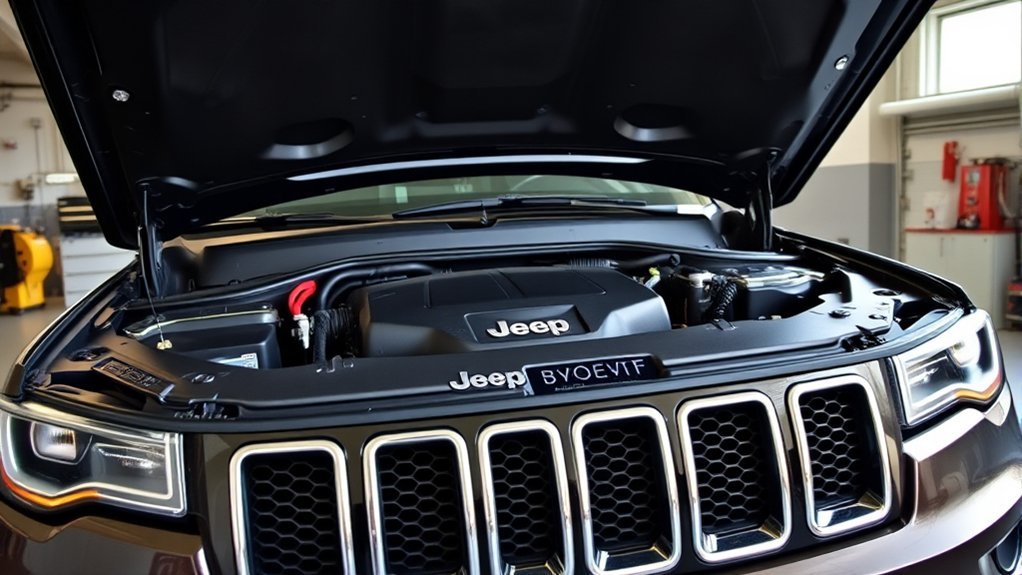
The Jeep Grand Cherokee battery location depends on the vehicle’s generation, model year, and powertrain. Many 2011–2021 WK2 models have the main 12-volt battery under the front passenger seat, while newer WL gasoline models may place the main battery under the driver seat. Grand Cherokee 4xe models use a different rear-cargo-area location for the 12-volt battery.
Quick Answer
Most WK2 Grand Cherokees place the main 12-volt battery under the front passenger seat. WL gasoline models generally place the main battery under the driver seat, with an auxiliary battery under the passenger seat on some configurations. Grand Cherokee 4xe models place the 12-volt battery beneath the rear cargo floor.
Key Takeaways
- Do not assume every Grand Cherokee has its battery under the passenger seat.
- Identify whether the vehicle is an older WK, a WK2, a gasoline WL, or a Grand Cherokee 4xe before removing interior panels.
- Use the marked remote positive and negative posts under the hood for jump-starting.
- Choose a replacement by VIN and original specifications rather than assuming that one battery group fits every model.
- Never touch orange high-voltage cables or attempt to service the Grand Cherokee 4xe traction battery.
At a Glance
| Time Required | 5–15 minutes to locate or access; about 30–60 minutes for a typical 12-volt battery replacement |
| Difficulty | Easy to moderate, depending on the location and whether the seat has power |
| Tools Needed | Owner’s manual, safety glasses, chemical-resistant gloves, socket set, ratchet, terminal brush, and a 12-volt booster or charger when needed |
| Cost | Locating or inspecting the battery costs nothing; replacement cost varies by battery type, model, auxiliary-battery equipment, and labor |
Where Is the Battery Located in a Jeep Grand Cherokee?
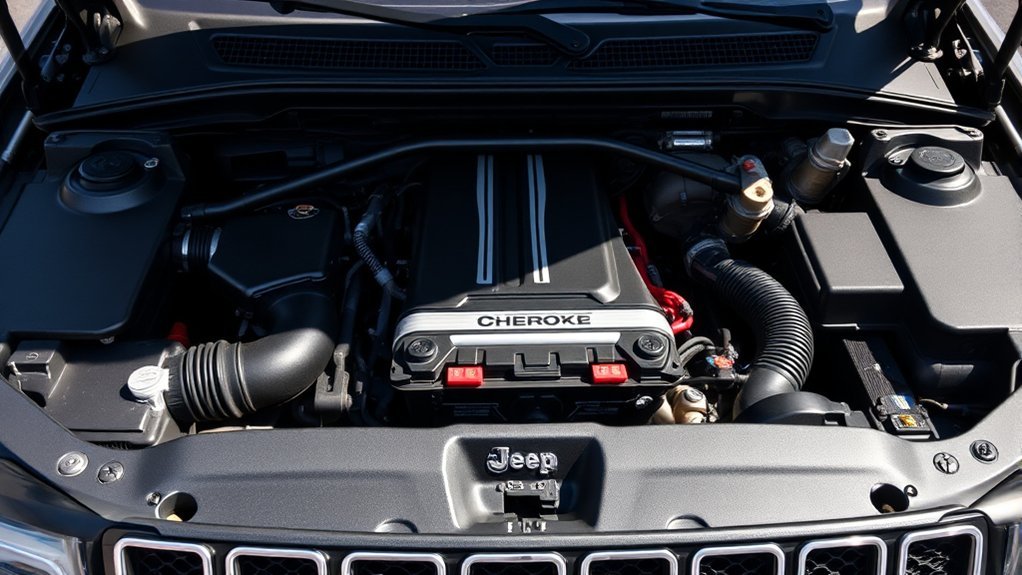
There is no single location that applies to every Jeep Grand Cherokee. The vehicle has been produced through several generations, and Jeep changed the battery layout as the platform and powertrain evolved.
| Model family | Typical 12-volt battery location | What to know |
|---|---|---|
| Older WK and earlier models | Engine compartment | The official 2010 guide places the battery at the front of the engine compartment behind the left headlight. Earlier years can differ, so verify the owner’s manual. |
| WK2 Most 2011–2021 models and the 2022 WK carryover |
Under the front passenger seat | The floor access panel is normally reached from the rear passenger footwell after moving the front seat. |
| WL gasoline models Grand Cherokee L and newer two-row models |
Main battery under the front driver seat | Some configurations also have an auxiliary battery under the front passenger seat. Jeep lists this main-and-auxiliary arrangement for the 2026 model. |
| Grand Cherokee 4xe | 12-volt battery beneath the rear cargo floor, near or under the spare-tire area | The high-voltage traction battery is a separate system underneath the vehicle and is not a do-it-yourself service item. |
Note: Model years 2021 and 2022 can be confusing because WK2 and WL vehicles overlap. Use the body style, model code, powertrain, VIN information, and owner’s manual rather than relying on the model year alone.
The battery may be hidden inside the cabin to protect it from engine heat and free space under the hood. Regardless of its physical location, gasoline Grand Cherokees normally provide remote jump-start terminals under the hood, so you do not need to uncover the battery to connect jumper cables.
How to Confirm Your Exact Battery Location
- Identify the generation and powertrain. Determine whether the vehicle is a WK2, gasoline WL, Grand Cherokee L, or Grand Cherokee 4xe.
- Check the owner’s manual. Search the manual for “battery,” “preparations for jump start,” or “12-volt battery location.”
- Look for the original battery label. It shows the battery technology, capacity information, terminal arrangement, and other replacement details.
- Verify by VIN before purchasing a replacement. A parts department or reputable battery fitment catalog can account for the engine, stop/start system, auxiliary battery, and factory electrical equipment.
Do not remove both front-seat access covers simply to search for a battery. Confirm the layout first so you do not disturb wiring, seat connectors, or interior trim unnecessarily.
How to Access an Under-Seat Grand Cherokee Battery
Warning: Wear safety glasses and chemical-resistant gloves. Do not work near cigarettes, flames, sparks, or a battery that is frozen, cracked, swollen, leaking, or unusually hot. Lead-acid batteries contain corrosive acid and can release flammable hydrogen gas.
- Park on level ground. Shift into Park, apply the parking brake, switch the ignition off, and turn off every electrical accessory.
- Keep the key away from the vehicle. This reduces the chance of modules waking up while you work.
- Move the seat for access. On many under-seat layouts, moving the seat forward and raising it exposes the floor cover from the rear footwell. Follow the position stated in the manual for your model.
- Remove the floor mat and access cover. Release the cover fasteners without forcing the surrounding trim.
- Inspect before touching the cables. Look for corrosion, loose clamps, a damaged case, a disconnected vent tube, or moisture in the battery compartment.
- Allow enough working room. A vehicle battery is heavy. Keep your back straight, grip it securely, and lift with your legs.
Pro Tip: If the battery is dead and the power seat will not move, connect a correctly rated 12-volt booster to the marked remote terminals under the hood. This may restore enough low-voltage power to operate the seat. Do not use a source above 12 volts or force the seat mechanism.
How to Choose the Correct Replacement Battery
A Group 65 battery is not a universal Grand Cherokee replacement. Battery requirements can change with the year, platform, engine, stop/start system, climate package, and auxiliary-battery equipment.
Before buying a battery, match all of the following:
- Physical group size: The replacement must fit the tray, hold-down, and access opening.
- Battery technology: Replace an AGM, EFB, or flooded battery with the technology specified for the vehicle. Do not downgrade an AGM-equipped electrical system to a basic flooded battery.
- Cold-cranking amps and reserve capacity: Meet or exceed the original specifications without changing the required physical fit.
- Terminal position and polarity: The positive and negative posts must match the original cable layout.
- Vent connection: An interior-mounted battery must have the correct vent port and a securely connected vent tube.
- Auxiliary battery: Check whether the vehicle has a second low-voltage battery for its stop/start or electrical system.
Note: Matching only the battery’s exterior dimensions is not enough. Verify the VIN, original label, battery technology, terminal layout, venting, and electrical capacity before installation.
How to Replace the 12-Volt Battery
A careful owner with suitable tools can replace many Grand Cherokee 12-volt batteries. However, access is confined, the battery is heavy, and some newer vehicles have auxiliary batteries or electrical reset procedures. Use the service information for your exact vehicle.
- Record the original installation. Photograph the cable positions, vent tube, hold-down, insulating covers, and battery orientation.
- Wait for the vehicle to shut down. Turn the ignition off, close unnecessary doors, keep the key away, and allow the electronic modules to power down.
- Disconnect the negative cable first. Secure it where it cannot spring back against the terminal.
- Disconnect the positive cable. Prevent the tool from touching grounded metal while it contacts the positive terminal.
- Disconnect the vent tube and battery sensor connections. Do not pull on the wires or damage the vent fitting.
- Remove the hold-down. Keep the fasteners organized and note the hold-down position.
- Lift out the battery. Keep it upright and use a lifting strap or a second person if needed.
- Clean and inspect the compartment. Address corrosion, moisture, damaged cables, or a blocked vent before installing the replacement.
- Install the replacement in the same orientation. Refit and tighten the hold-down so the battery cannot move.
- Reconnect the vent tube. Make sure the unused vent port is sealed when the battery design requires it.
- Reconnect positive first and negative last. Reinstall all terminal covers and the floor access panel.
- Test the vehicle. Confirm normal starting, charging voltage, warning-light operation, seat movement, window functions, and stop/start behavior. Some learned settings may require a relearn procedure.
Warning for 4xe Owners: This replacement procedure applies only to the conventional 12-volt battery when the owner’s manual permits access. Do not remove covers from the high-voltage traction battery, disconnect orange cables, or touch high-voltage connectors. High-voltage work belongs to trained technicians.
Return the old lead-acid battery to a battery retailer, dealership, or approved household hazardous-waste program. Do not place it in household trash or a curbside recycling bin.
Tips for Maintaining Your Jeep’s Battery Health
A fixed seven-year replacement schedule is not a reliable maintenance plan. The EPA’s 2026 battery report lists three to five years as a common lifespan for automotive lead-acid starting batteries, but climate, short trips, deep discharges, vibration, charging performance, and electrical loads can shorten or extend service life.
| Maintenance check | What to do |
|---|---|
| Terminal condition | Check for loose clamps, white or green corrosion, damaged insulation, and overheated connections. |
| Battery test | Have the battery load-tested as it ages, before extreme weather, or whenever cranking becomes slower. |
| Vent tube | Confirm that an interior-mounted battery’s vent tube is connected, undamaged, and routed outside the passenger compartment. |
| Hold-down | Make sure the battery cannot slide or tip. Vibration and movement can damage the battery and cables. |
| Long storage | Use a battery maintainer compatible with the installed battery technology, following both the vehicle and charger instructions. |
| Signs of discharge | Investigate slow cranking, clicking, dim lights, stop/start warnings, repeated clock resets, or accessories shutting down. |
Pro Tip: A portable jump starter is useful for emergencies, but it is not a substitute for finding the cause of repeated discharge. Test the main battery, auxiliary battery if equipped, charging system, cable voltage drop, and key-off current draw.
Jump-Starting Your Grand Cherokee Safely
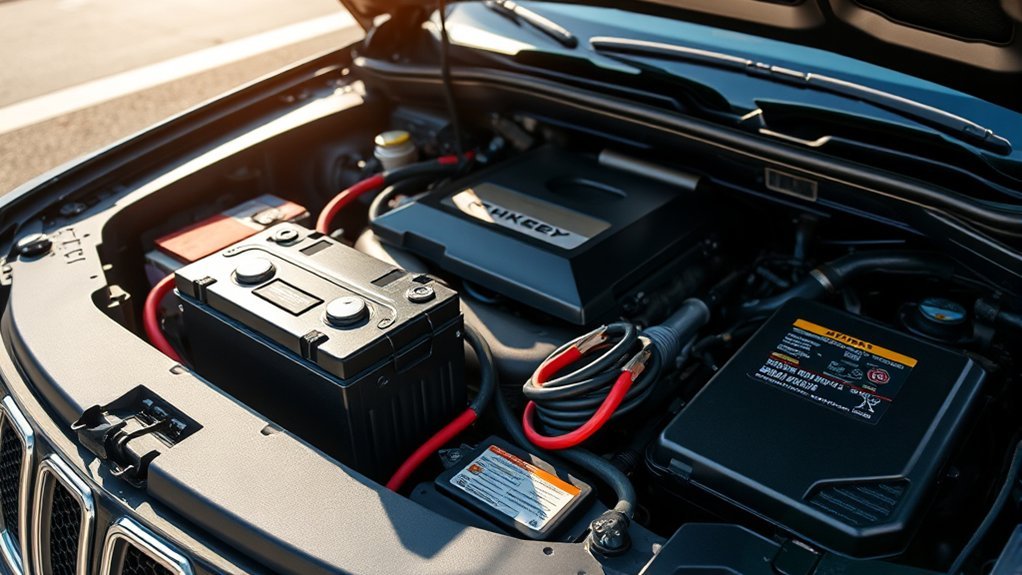
You normally do not need to uncover the interior battery to jump-start a Grand Cherokee. Use the marked remote positive and negative posts under the hood.
Warning: Do not jump-start a frozen, cracked, swollen, leaking, or overheated battery. Keep the vehicles from touching, remove metal jewelry, stay clear of the cooling fan, and use only a 12-volt booster source. Never clamp onto a fuse or an unmarked terminal.
Prepare for the Jump-Start
- Position the donor vehicle or booster so the cables reach without stretching.
- Place both vehicles in Park and apply both parking brakes.
- Switch off the ignition, heater, radio, lights, and other accessories.
- Open the Grand Cherokee’s positive-post cover and identify the marked remote negative or ground post.
- Keep unused clamp ends from touching each other or either vehicle.
Connect the Jumper Cables in This Order
- Connect the positive red clamp to the Grand Cherokee’s remote positive post.
- Connect the other positive red clamp to the donor battery’s positive terminal.
- Connect the negative black clamp to the donor battery’s negative terminal.
- Connect the final negative black clamp to the Grand Cherokee’s marked remote negative post or approved exposed ground point—not directly to the buried battery terminal.
Start the Vehicles
- Start the donor vehicle and allow it to idle for a few minutes. Do not race the donor engine.
- Attempt to start the Grand Cherokee.
- If it does not start after a few brief attempts, stop. Recheck the connections and arrange testing rather than overheating the starter or cables.
- Once the Grand Cherokee starts, proceed directly to the disconnection sequence.
Disconnect the Cables in Reverse Order
- Remove the negative clamp from the Grand Cherokee’s remote negative or ground post.
- Remove the negative clamp from the donor battery.
- Remove the positive clamp from the donor battery.
- Remove the positive clamp from the Grand Cherokee’s remote positive post.
- Reinstall the positive-post protective cover.
The safest jump point is the marked under-hood remote terminal—not the battery hidden beneath a seat or cargo panel.
Do not assume that a few minutes of idling has fully recharged a deeply discharged battery. Have the battery and charging system tested. A compatible battery charger may be needed to restore the battery properly.
4xe Note: The 12-volt system must power up the high-voltage system. If both the 12-volt and high-voltage batteries are depleted, the vehicle may need 12-volt jump power before it can begin charging from a Level 1 or Level 2 charging source. Follow the 4xe supplement exactly.
What to Do if the Battery Still Does Not Work
A no-start condition is not always caused by the main battery. Use the symptom pattern to narrow down the problem instead of replacing parts at random.
| Symptom | Possible causes | Next step |
|---|---|---|
| No lights and no crank | Fully discharged battery, loose terminal, poor ground, damaged cable, or main power fuse | Test voltage at the remote posts, then inspect the battery terminals, grounds, and high-current fuses. |
| Rapid clicking or dim lights | Weak battery, corrosion, loose connection, or excessive cable resistance | Load-test the battery and perform voltage-drop tests on the positive and ground cables. |
| One solid click | Weak voltage, starter relay, starter solenoid, starter motor, or cable problem | Confirm battery condition and cable voltage before condemning the starter. |
| Engine cranks normally but does not start | Fuel, ignition, security, sensor, or engine-control issue | Stop focusing only on the battery and scan the vehicle for diagnostic trouble codes. |
| Starts with a jump but dies or shows a charging warning | Charging-system, belt, cable, sensor, or module fault | Test charging voltage and current. Do not replace the alternator without confirming the diagnosis. |
| Battery repeatedly dies while parked | Parasitic draw, failing auxiliary battery, module staying awake, aftermarket equipment, or defective main battery | Fully charge and test the batteries, then perform a key-off current-draw test after the modules enter sleep mode. |
| New battery installed but systems remain dead | Reversed or loose connection, disconnected sensor, blown main fuse, incorrect battery, or module communication issue | Recheck the installation and fuses, then use a suitable scan tool to inspect the Body Control Module and other networked modules. |
The Power Distribution Center under the hood contains fuses and relays that can interrupt vehicle power when damaged. Check only the fuses identified in the owner’s manual. Do not replace a fuse with a higher rating or probe high-voltage 4xe circuits.
When to Call in a Professional for Battery Troubles
Contact a qualified technician or roadside-assistance provider when:
- The battery is frozen, cracked, swollen, leaking, smoking, or hot.
- The vehicle still has no electrical power after a verified battery and secure connections.
- The battery repeatedly drains while the vehicle is parked.
- A new battery or alternator did not correct the problem.
- The vehicle cranks normally but will not start.
- The stop/start, charging, or battery warning remains on.
- Testing requires removal of seat wiring, high-current fuses, or networked electrical modules.
- You see damaged orange cables or suspect a Grand Cherokee 4xe high-voltage fault.
An ASE-certified or Jeep-trained technician can test the battery under load, check the main and auxiliary charging circuits, measure parasitic draw, perform cable voltage-drop tests, and scan the Body Control Module and other systems before parts are replaced.
Frequently Asked Questions
Can I replace the Jeep Grand Cherokee battery myself?
Yes, many owners can replace the conventional 12-volt battery with suitable tools and safe lifting technique. Confirm the location and specifications first, disconnect negative before positive, reconnect positive before negative, and restore the vent tube. Seek professional help for damaged batteries, difficult auxiliary-battery systems, or any 4xe high-voltage work.
How long does a Jeep Grand Cherokee battery typically last?
A common planning range for a lead-acid starting battery is about three to five years, but heat, cold, short trips, deep discharges, vibration, electrical loads, and charging-system condition can change that range. Test the battery based on age and symptoms rather than waiting for a fixed seven-year deadline.
What tools do I need to access the battery?
Typical tools include safety glasses, chemical-resistant gloves, a socket set, ratchet, extensions, terminal brush, and a battery lifting strap. Exact fastener sizes vary. A correctly rated 12-volt booster may also be useful if a dead battery prevents the power seat from moving.
Is there one battery group size for every Grand Cherokee?
No. Do not assume that every Grand Cherokee uses Group 65 or any other single size. The correct group, battery technology, capacity, terminal arrangement, vent port, and auxiliary-battery requirement depend on the VIN, year, platform, engine, and factory equipment.
Can extreme temperatures affect battery performance?
Yes. Cold weather reduces available cranking performance while the engine requires more power to turn. High heat speeds battery deterioration and water loss in applicable designs. Testing before seasonal temperature extremes can reveal a weakening battery before it leaves the vehicle unable to start.
Where is the 12-volt battery in a Grand Cherokee 4xe?
The conventional 12-volt battery is beneath the rear cargo floor near or under the spare-tire area. It is separate from the high-voltage traction battery underneath the vehicle. Do not open or service the high-voltage battery case or orange high-voltage connections.
How do I move the seat if the battery is completely dead?
Connect a properly rated 12-volt booster to the marked remote jump posts under the hood, following the vehicle and booster instructions. This may provide enough power to move the seat. Do not force the seat tracks, connect to random fuses, or use a booster source above 12 volts.
Conclusion
The correct Jeep Grand Cherokee battery location depends on the generation and powertrain. WK2 models generally place the main battery under the passenger seat, WL gasoline models generally place it under the driver seat, and Grand Cherokee 4xe models place the 12-volt battery beneath the rear cargo floor. Confirm the exact layout by VIN and owner’s manual before removing panels or buying a replacement.
Use the marked under-hood posts for jump-starting, match every replacement specification, keep interior battery venting intact, and investigate repeated discharge instead of relying on another jump. When a battery is damaged, electrical faults persist, or high-voltage 4xe components are involved, leave the repair to a qualified technician.
Sources
- Jeep Grand Cherokee Frequently Asked Questions — current main-battery, auxiliary-battery, and remote-terminal information.
- 2010 Jeep Grand Cherokee User Guide — older engine-compartment battery location.
- 2021 Jeep Grand Cherokee Owner’s Manual — WK2 passenger-seat location and remote jump posts.
- 2022 Grand Cherokee and Grand Cherokee L Owner’s Manual — WL driver-seat location and official jump-start procedure.
- 2024 Jeep Grand Cherokee 4xe Hybrid Supplement — 12-volt cargo-area location, jump-starting, and high-voltage safety.
- U.S. EPA Battery Collection Best Practices Report — lead-acid battery lifespan and responsible battery collection.







Leave a Reply