
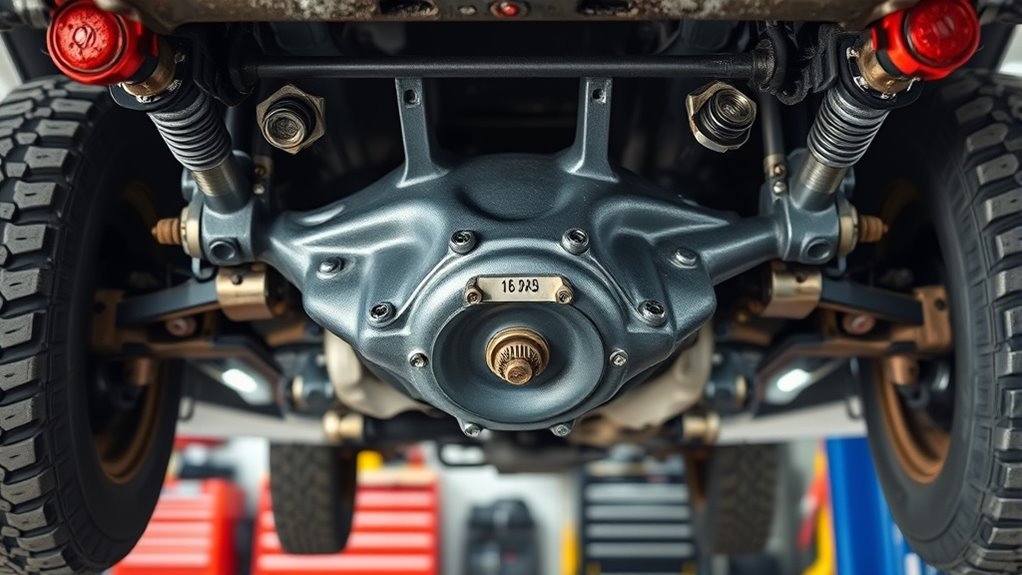
Vari-Lok is a progressive limited-slip differential most closely associated with 1999–2004 Jeep Grand Cherokee WJ models equipped with the original Quadra-Drive system. The most reliable way to identify it is to check the Jeep’s factory equipment record and then confirm that the original axles are still installed. Badges, axle tags, and visual clues can help, but none should be used alone.
Quick Answer
First confirm that the vehicle is a 1999–2004 Grand Cherokee WJ. Then check its factory equipment record for Quadra-Drive or Vari-Lok front and rear axles. A Quadra-Drive badge or bezel is a useful clue, but the build sheet or axle assembly number is stronger proof. Do not rely on a tire-spin test alone.
Key Takeaways
- Factory Jeep Vari-Lok applications are primarily associated with the 1999–2004 Grand Cherokee WJ and its Quadra-Drive system.
- The strongest evidence is a factory equipment record that lists Quadra-Drive or Vari-Lok front and rear axles.
- Exterior housing shape, wheel rotation, stickers, and badges are clues rather than conclusive tests.
- A build sheet shows the original configuration, so a modified Jeep or swapped axle still needs a physical inspection.
At a Glance
| Time Required | 5–20 minutes for a record and exterior check; longer if an axle must be opened |
| Difficulty | Easy for records and tags; advanced for internal inspection |
| Tools Needed | Full VIN, flashlight, phone or computer, shop towel, and model-year service information |
| Cost | Usually $0 for records and visual checks; shop inspection costs vary |
What Is Vari-Lok, and Which Jeeps Used It?
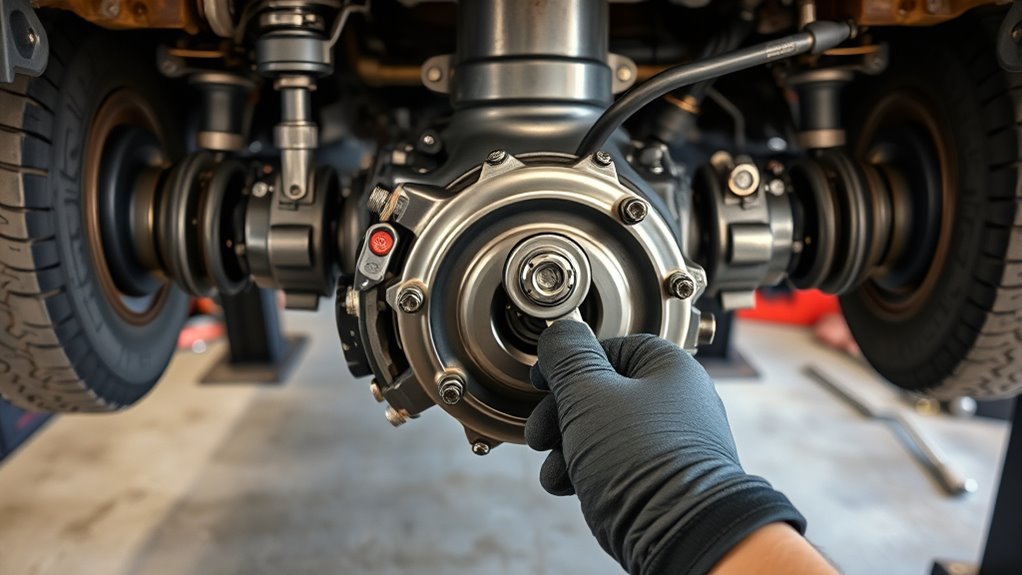
Vari-Lok is an automatic, speed-sensitive limited-slip differential. When one wheel on an axle begins turning faster than the other, an internal hydraulic pump and clutch system progressively sends more torque toward the wheel with better grip. It works without a dashboard switch and is not the same as a driver-selectable locking differential.
The factory Jeep application most owners are looking for is the 1999–2004 Grand Cherokee WJ with Quadra-Drive. Jeep’s historical description explains that the original Quadra-Drive system combined Quadra-Trac with Vari-Lok front and rear progressive axles.
Vari-Lok is a progressive limited-slip system, not a selectable locker. There is no factory button that locks and unlocks the axle on demand.
Note: A newer Jeep with Quadra-Drive II does not automatically have Vari-Lok. Modern Quadra-Drive II systems use electronic limited-slip technology and should be identified using the information for that exact model year.
How to Tell If Your Jeep Has Vari-Lok
Use the following checks in order. The first methods provide stronger evidence than a badge, sticker, or wheel-spin observation.
1. Confirm the Model Year and Generation
Start by confirming that the Jeep is a 1999–2004 Grand Cherokee WJ. The model year appears in the VIN, registration, title, and driver-door certification label. Vari-Lok was part of the original WJ-era Quadra-Drive system, so a Wrangler, Cherokee, Liberty, or later Grand Cherokee should not be assumed to have it simply because it has four-wheel drive.
A 2005 or newer Grand Cherokee may carry the Quadra-Drive II name, but that is a later system. Jeep currently describes Quadra-Drive II as using a rear electronic limited-slip differential, not the original WJ Vari-Lok axle design.
2. Check for Quadra-Drive Markings
Look for an original Quadra-Drive badge, transfer-case bezel, owner documentation, or window-sticker description. A factory Quadra-Drive marking is a strong clue because the WJ Quadra-Drive package used Vari-Lok differentials in both axles.
However, badges and trim pieces can be removed, replaced, or added to another Jeep. Use them to support the identification, not as final proof.
3. Retrieve the Factory Equipment Record
Enter the full 17-character VIN in the Mopar Vehicle Equipment area or ask an authorized Jeep dealer to print the factory equipment or build record. Wording can vary, but look for entries such as:
- Quadra-Drive 4WD system
- Vari-Lok progressive front axle
- Vari-Lok progressive rear axle
- Front and rear axle assembly descriptions or sales codes that a dealer can decode
This is normally the fastest and safest way to confirm how the Jeep left the factory.
Pro Tip: Save a PDF or printed copy of the equipment record. It can help when ordering axle seals, bearings, differential parts, fluids, and other drivetrain components.
4. Inspect the Axle Tags and Assembly Numbers
If the equipment record is unavailable or the Jeep may have been modified, inspect both axle housings for original metal tags, stamped numbers, or identification labels. Clean the area gently with a shop towel and record every number before trying to interpret it.
An axle tag may identify the assembly, build date, or gear ratio, but it may not spell out “Vari-Lok.” Cross-reference the full axle assembly number with an OEM parts catalog, model-year service information, or a Jeep dealer. Do not assume that a 3.73 ratio proves the presence of Vari-Lok; axle ratio and differential type are separate specifications.
5. Confirm the Installed Hardware If the Jeep Was Modified
A factory record confirms the Jeep’s original equipment, not necessarily what is installed today. A previous owner may have replaced an axle, installed a standard open carrier, fitted an aftermarket limited-slip differential, or swapped in a complete used housing.
If the build record and physical axle numbers disagree, the installed axle must be identified by its assembly number or by an internal inspection. Removing the differential cover allows a trained technician to identify the carrier and inspect the lubricant, bearings, clutch components, and gear condition.
Warning: Never crawl under a Jeep supported only by a hydraulic jack. Use level ground, wheel chocks, manufacturer-approved lifting points, and correctly rated jack stands. Differential-cover removal also requires proper fluid disposal, resealing, refilling, and torque procedures.
Visual Inspection: What You Can and Cannot See
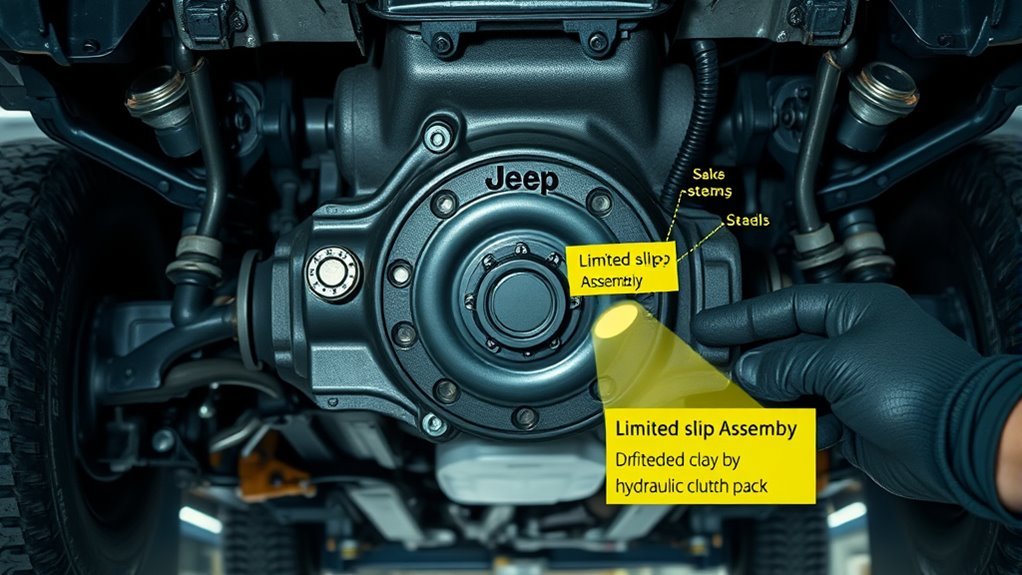
An exterior inspection can uncover useful evidence, but the outside of the axle is not always enough to identify the internal differential.
Useful exterior clues include:
- Original axle assembly tags or stamped identification numbers
- A factory Quadra-Drive badge or equipment record
- Evidence that the housing, cover, brackets, or fasteners have been replaced
- Electrical wiring, air lines, or cables that may reveal an aftermarket locker or another axle system
Clues that are not dependable by themselves include:
- A “squared” exterior housing or cover shape
- The presence or absence of a sticker
- A particular gear ratio
- A vacuum actuator or external electronic solenoid
The Vari-Lok carrier is inside the axle. Its internal components differ from an open differential or Trac-Lok unit, but the exterior housing can look similar. Vari-Lok also does not require an axle-mounted vacuum actuator or electrical locking solenoid. Finding one of those components may indicate a different factory system or an aftermarket modification.
Why the Tire-Spin Test Is Not Proof
A common limited-slip test involves raising both wheels on an axle and turning one tire by hand. People often claim that matching wheel rotation proves the presence of Vari-Lok. That conclusion is too strong.
The result can change because of:
- Brake drag or parking-brake adjustment
- Clutch-pack wear
- Incorrect or contaminated lubricant
- Driveshaft and transfer-case resistance
- Whether the transmission and transfer case are correctly positioned
- An aftermarket carrier or previously swapped axle
An open differential can also produce confusing wheel movement when one side has more drag than the other. Likewise, a worn Vari-Lok unit may not behave as expected during a hand test.
Use wheel rotation only as a secondary observation after checking the model year, factory equipment record, and axle identification numbers. It should not override conflicting documentation or physical part numbers.
How to Use the VIN to Check for Vari-Lok
Locate the Full VIN
The Jeep’s 17-character VIN can normally be found in these locations:
- At the lower driver-side corner of the windshield
- On the driver-door or door-jamb certification label
- On the registration, title, or insurance documents
Copy all 17 characters carefully. Similar-looking letters and numbers can produce an incorrect result.
Understand What a VIN Decoder Can Show
The NHTSA VIN Decoder can confirm manufacturer-reported information such as vehicle identity, model year, engine-related data, and manufacturing details. It is useful for confirming that the vehicle is the expected model and generation.
However, a public VIN decode does not always display every factory option. Do not assume that one VIN character directly identifies the axle differential. The fifth character is not a universal Vari-Lok or axle code across every Jeep year and market.
Use the VIN to Get the Build Record
The better approach is to use the VIN to retrieve the manufacturer’s equipment record through Mopar or an authorized Jeep dealer. Ask specifically whether the original build included:
- Quadra-Drive
- A Vari-Lok front axle
- A Vari-Lok rear axle
- The original axle assembly and ratio codes
Note: The build record answers “How was this Jeep built?” Physical tags and internal inspection answer “What is installed now?” Both questions matter on an older or modified Grand Cherokee.
Quadra-Drive vs. Quadra-Trac: What the Names Mean
| System | What It Means for Vari-Lok Identification |
| WJ Quadra-Trac II | Identifies the full-time, two-speed transfer-case system. The Quadra-Trac II name by itself does not confirm Vari-Lok axles. |
| WJ Quadra-Drive | Combines the Quadra-Trac transfer-case system with factory Vari-Lok progressive differentials in the front and rear axles. |
| Later Quadra-Drive II | Uses later electronic traction and limited-slip technology. The Quadra-Drive II name does not prove that the Jeep has original WJ-style Vari-Lok axles. |
For a WJ owner, the important distinction is that Quadra-Drive added the Vari-Lok axle package. A Jeep described only as having Quadra-Trac II needs further verification.
How to Maintain a Vari-Lok Differential
Correct fluid is critical because Vari-Lok depends on internal hydraulic action and clutch friction. Do not treat the axle and transfer case as though they use the same lubricant.
Vari-Lok Axle Fluid
For the 2001 Grand Cherokee, Chrysler’s official fluids and lubricants chart specifies SAE 75W-140 API GL-5 synthetic gear lubricant for Vari-Lok-equipped front and rear axles and states that Vari-Lok axles require friction modifier.
Specifications, capacities, additive quantities, and part numbers can vary by model year and axle assembly. Before servicing the axle, check the exact owner or service information for the VIN through the official Mopar owner-publication portal.
NV247 Transfer-Case Fluid
The Quadra-Drive system also uses an NV247 transfer case, but the transfer case does not use axle gear oil. Chrysler lists a dedicated Mopar transfer-case fluid for the Quadra-Trac system. Do not substitute axle lubricant or assume that ATF+4 is correct merely because another Jeep transfer case uses it.
Additional Maintenance Practices
- Check both axle housings and pinion areas for leaks.
- Repair leaking axle seals before the lubricant level becomes low.
- Use closely matched tires of the correct size and similar tread depth on all four corners.
- Investigate chatter that begins after an axle-fluid service.
- Inspect drained lubricant for water, metal particles, or a burned odor.
- Follow the maintenance schedule for the exact model year and operating conditions.
Warning: Adding an arbitrary amount of friction modifier can change clutch behavior. Use the specification for the exact axle and model year rather than relying on a universal bottle recommendation.
Signs of a Vari-Lok or Axle Problem
No single driving symptom proves that the Vari-Lok unit has failed. Use the following signs as reasons to inspect the entire axle and driveline:
- Chatter or binding in slow, tight turns: May result from incorrect lubricant, insufficient or excessive additive, contaminated fluid, tire mismatch, or clutch wear.
- Weak traction transfer: A worn clutch pack or internal pump may be possible, but tire condition and transfer-case operation must also be checked.
- Whine or howl that changes with speed or load: Often points toward bearings, ring-and-pinion setup, lubricant level, or gear wear rather than the Vari-Lok clutch alone.
- Clunking during acceleration or deceleration: Can come from driveshaft joints, suspension bushings, mounts, gear backlash, or other driveline components.
- Fluid leaks or metal in the lubricant: Require prompt inspection because low fluid or internal wear can damage the entire axle.
Uneven tire wear is not a specific Vari-Lok symptom. Check alignment, tire pressure, suspension parts, wheel bearings, and rotation history before blaming the differential.
When to Consult a Mechanic About Your Differential
Consult a qualified drivetrain or Jeep technician when:
- The equipment record and physical axle tags do not match.
- The axle has no readable identification tag.
- You suspect a previous axle or carrier swap.
- Chatter continues after the correct fluid service.
- The axle leaks, binds, howls, or contains visible metal particles.
- Internal carrier identification requires differential-cover removal.
- You are not equipped to lift and support the vehicle safely.
A technician can identify the installed axle assembly, inspect the carrier, check the clutch and pump components, measure gear backlash, examine bearings, and determine whether the symptom comes from Vari-Lok or another driveline part.
Frequently Asked Questions
Which Jeep models have locking differentials?
Jeep has used several different traction systems. A 1999–2004 Grand Cherokee WJ with factory Quadra-Drive uses front and rear Vari-Lok progressive limited-slip differentials, not driver-selectable lockers. Certain Wrangler Rubicon builds use selectable Tru-Lok differentials. Always verify the exact model year, trim, and factory equipment record.
Which is better, Quadra-Drive or Quadra-Trac?
On a WJ Grand Cherokee, Quadra-Drive adds front and rear Vari-Lok differentials to the Quadra-Trac transfer-case system, giving it better side-to-side torque management when a wheel loses traction. Quadra-Trac II can still be capable, but the name alone does not confirm Vari-Lok axles.
Can the VIN alone confirm that my Jeep has Vari-Lok?
The VIN is the key to retrieving the factory equipment record, but a basic character-by-character VIN decode may not list the differential option. Use the full VIN with Mopar’s vehicle-equipment system or ask a Jeep dealer for the original build record.
Does spinning one tire confirm a Vari-Lok differential?
No. Wheel movement can be affected by brake drag, clutch wear, fluid condition, driveline resistance, and the way the test is performed. Treat the result as an observation only and confirm the axle through equipment records, assembly numbers, or internal inspection.
Can a Jeep have Vari-Lok in only one axle?
A factory WJ Quadra-Drive build used Vari-Lok differentials in both the front and rear axles. An older Jeep may now have only one if a previous owner replaced an axle or differential carrier, so compare the factory record with the hardware currently installed.
Conclusion
The safest and most accurate way to determine whether a Jeep has Vari-Lok is to start with the model year and factory equipment record. A 1999–2004 Grand Cherokee WJ that was built with Quadra-Drive should have front and rear Vari-Lok differentials, but its current hardware still needs verification if the vehicle has been modified.
Use badges and surviving axle tags as supporting evidence. Do not depend on exterior housing shape, a vacuum actuator, one VIN character, or a tire-spin test. When records and physical parts disagree, an axle-number lookup or professional internal inspection provides the clearest answer.
Sources
- Stellantis Media: Jeep 80-Year History — explains the original Quadra-Drive and front/rear Vari-Lok combination.
- Stellantis Media: Grand Cherokee Generation History — identifies the 1999–2004 WJ generation and its Vari-Lok axle system.
- Chrysler 2001 Grand Cherokee Fluids and Lubricants Chart — supports axle and transfer-case fluid guidance.
- Mopar Vehicle Equipment — provides vehicle-specific factory equipment information.
- NHTSA VIN Decoder — supports VIN identification and explains the limits of manufacturer-reported VIN data.
- Jeep 4×4 Systems — distinguishes current Quadra-Drive II electronic limited-slip technology from the original Vari-Lok system.



Leave a Reply