
Supercharging a Jeep Grand Cherokee SRT is usually an $8,000–$13,000 installed project when you start with a healthy, mostly stock 6.4-liter WK2 and choose a complete street kit. Current kit prices alone run from about $6,100 to $9,000 before labor, tax, fluids, spark plugs, inspections, and any custom fuel or drivetrain work. Exact cost depends on the model year, kit type, emissions certification, and what the package already includes.
Quick Answer
Plan on roughly $8,000–$13,000 to supercharge a Jeep Grand Cherokee SRT with a complete kit and professional installation. Current kits cost about $6,118–$8,999.99. A custom build, extra cooling, fuel upgrades, repairs, taxes, or drivetrain work can push the total past $15,000.
Key Takeaways
- Complete Jeep SRT supercharger kits currently start near $6,100 and reach about $9,000, depending on brand, year, finish, and calibration package.
- A realistic installed budget is $8,000–$13,000 for a healthy stock vehicle; modified or higher-power builds can cost much more.
- Do not automatically add separate injector, fuel-pump, PCM-unlock, and tuning costs until you confirm what the selected kit includes.
- Manufacturer horsepower figures are not directly comparable because some are measured at the crank, some at the wheels, and some are reported customer results.
- Verify the exact model year, engine, CARB Executive Order, fuel requirement, and warranty terms before ordering.
At a Glance
| Time Required | About 8–12 shop hours for many complete installations, plus possible PCM shipping, calibration, inspection, and road-test time |
| Difficulty | Advanced; professional installation and calibration are strongly recommended |
| Tools Needed | Full mechanic’s tool set, torque wrench, lifting equipment, cooling-system service tools, scan/tuning hardware, and kit-specific tools |
| Cost | About $6,118–$8,999.99 for current kit examples; roughly $8,000–$13,000 installed for many stock-engine builds |
Confirm Your Jeep SRT Model Year and Engine First
This pricing guide mainly covers the 2012–2021 WK2 Jeep Grand Cherokee SRT/SRT8 with the 6.4-liter HEMI. Earlier 2006–2010 Grand Cherokee SRT8 models use the 6.1-liter HEMI and require different kits. Fitment also changes within the WK2 run because later vehicles use different PCM security and calibration procedures.
Before buying, match the kit to the exact year, engine, VIN, stock or modified engine status, exhaust setup, fuel availability, and emissions requirements. ProCharger lists a 2012–2020 6.4-liter application, RIPP lists separate year-group kits through 2018, and Whipple lists dedicated packages through 2021. A product that fits one WK2 year may not legally or electronically fit another.
Pro Tip: Give the seller and installer your full VIN before paying. Ask for the exact part number, included calibration hardware, fuel requirements, CARB Executive Order number, and a written installed quote.
Understanding Supercharging: What It Means for Your Jeep SRT
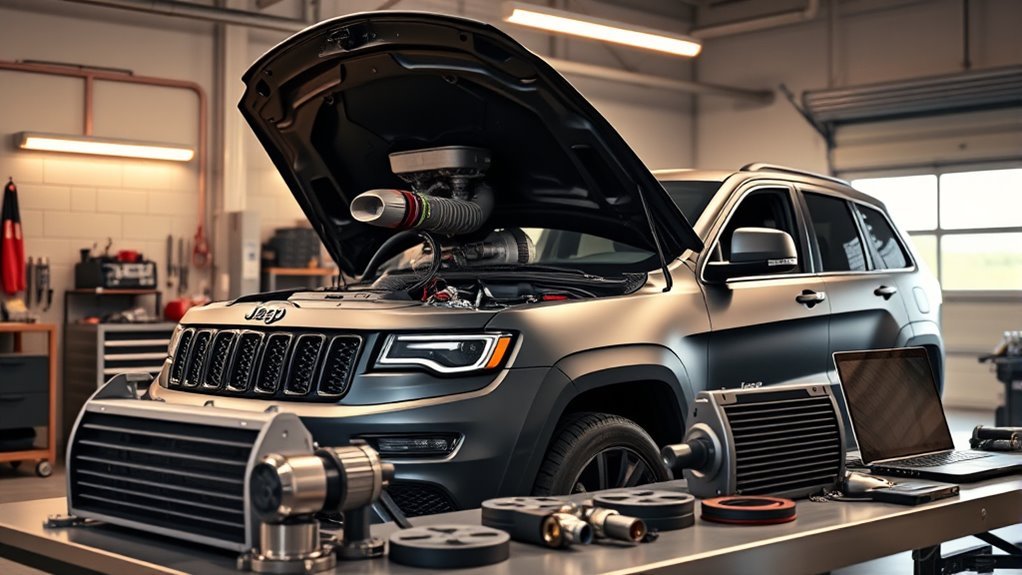
A supercharger forces more air into the engine so the calibration can add more fuel and make more power. The common Jeep SRT kits use either a centrifugal supercharger or a twin-screw supercharger.
- Centrifugal systems, such as ProCharger and RIPP’s Vortech-based kit, build boost as engine speed rises. They usually feel progressive and can package an air-to-air intercooler in front of the radiator.
- Twin-screw systems, such as Whipple’s Gen 6 kit, produce strong low- and mid-range boost and use a liquid-cooled intercooler system beneath the supercharger.
A complete kit may include the supercharger, brackets, belt drive, intercooler, intake piping, injectors, fuel support, tuning device, calibration, and PCM services. A cheaper tuner kit may omit fuel-system parts and calibration because it is intended for a custom build. That difference is crucial when comparing prices.
What Are the Costs of Jeep SRT Supercharger Kits?
As of July 19, 2026, current manufacturer-listed examples for the 6.4-liter WK2 range from about $6,118 to $8,999.99. Prices can change, and finishes, head-unit upgrades, flash tools, shipping, taxes, or custom options may raise the total.
| Kit example | Listed fitment | Current listed price | Important note |
|---|---|---|---|
| RIPP complete kit | 2012–2014 6.4L | From $6,118 | Lower-cost tuner variants are not equivalent to a complete calibrated package |
| RIPP complete kit | 2016–2018 6.4L | From $6,562 | Page lists professional installation, injectors, HP Tuners device, PCM unlock service, and RIPP calibration |
| ProCharger system | 2012–2020 6.4L | From $7,798 | Configuration and emissions options affect price |
| Whipple Gen 6 3.0L | 2015–2017 6.4L | $8,899.99 | Includes high-flow injectors, fuel rails, pump voltage booster, HP Tuners support, and PCM-unlock workflow |
| Whipple Gen 6 3.0L | 2018–2021 6.4L | $8,999.99 | Includes injectors, fuel rails, PCM-unlock support, security-bypass support, and HP Tuners RTD support |
Note: A lower advertised “tuner kit” price can be misleading if it excludes injectors, fuel-pump support, a tuning device, calibration, or PCM work. Compare the complete parts list—not just the headline price.
Installed Cost Breakdown
The kit is the largest expense, but it is not the whole project. The ranges below are planning allowances, not fixed national rates. Labor and diagnostic prices vary widely by shop and region.
| Cost item | Typical planning range | What changes the price |
|---|---|---|
| Complete supercharger kit | $6,118–$8,999.99 | Model year, head unit, finish, calibration, emissions certification, and included fuel parts |
| Professional labor | About $1,000–$2,500 | Shop rate, 8–12 hours of work, seized hardware, fabrication, and troubleshooting |
| Pre-install inspection and baseline testing | About $150–$500 | Compression/leak-down testing, scan data, cooling-system pressure test, and baseline dyno pull |
| Spark plugs, fluids, belts, clamps, and shop supplies | About $150–$600 | Kit requirements and the condition of existing maintenance parts |
| PCM unlock, security bypass, tuning device, or custom tune | $0–$1,500+ | Often included with a complete kit; more likely extra with a tuner kit or modified engine |
| Optional fuel, cooling, or drivetrain upgrades | $500–$5,000+ | Power goal, ethanol use, track use, heat management, transmission condition, axles, tires, and brakes |
| Tax, shipping, and downtime | Varies | Location, freight policy, PCM shipping, and parts availability |
For a stock, healthy WK2 SRT, the safest budget is not the kit price—it is the complete installed price plus a repair reserve.
Installation Expenses: What to Expect From Labor
RIPP describes its 6.4-liter kit as a professional-install product and lists roughly 8–10 hours on its current product page, although another section references 6–8 hours. Real shop time can be longer when the technician must unlock or ship the PCM, install a security bypass, replace worn parts, pressure-test the intercooler system, load the calibration, clear faults, and verify fuel and boost data.
Whipple describes its current system as a complete bolt-on package with no internal engine modifications required. “Bolt-on,” however, does not mean beginner-level. The work affects the intake, accessory drive, cooling system, fuel system, sensors, wiring, and engine calibration. A shop familiar with late-model HEMI tuning is worth more than the lowest hourly rate.
Ask the installer whether the quote includes:
- Pre-install scan, compression or leak-down testing, and a cooling-system check
- PCM unlock and shipping coordination, if required
- Security-bypass installation on applicable years
- Spark plugs, fluids, belts, clamps, and shop supplies
- Calibration loading, data logging, and a final road or dyno verification
- Labor warranty and follow-up inspection after the first heat cycles
Additional Modifications: Fuel Systems and Tuning Costs
Fuel and tuning costs depend on whether you buy a complete kit or a tuner package. The original assumption that every Jeep SRT needs another $1,000–$3,000 in fuel upgrades is too broad. Current complete RIPP and Whipple packages already list injectors and calibration-related hardware, while ProCharger explains that its tuner kits omit fuel-system upgrades and tuning for custom builds.
Fuel System Upgrades
A complete low-boost street kit may already provide the injectors and fuel support needed for its supplied calibration. Whipple’s 2015–2017 package lists high-flow injectors, billet fuel rails, and a fuel-pump voltage booster. Its 2018–2021 package lists high-flow injectors and fuel rails. RIPP lists plug-and-play injectors with its complete system.
Extra fuel-system cost becomes more likely when you choose a tuner kit, increase boost, add a cam or headers, run ethanol blends, or aim beyond the complete kit’s supported configuration. Those builds may require larger injectors, one or more pumps, upgraded wiring, fuel-pressure monitoring, and a fully custom calibration.
Tuning, PCM Unlock, and Security Bypass
Do not assume tuning is always a separate $300–$1,200 purchase. RIPP’s complete kit lists an HP Tuners RTD device, PCM unlock service, and a RIPP calibration. Whipple’s current kits include HP Tuners support and an emissions-compliant calibration workflow for the supported stock configuration.
Later WK2 vehicles need extra electronic steps. Whipple’s official HP Tuners instructions state that 2015-and-newer PCMs must be unlocked before flashing and that 2018-and-newer vehicles require a security bypass. The same instructions warn that mixing PCM files or changing the locked calibration can damage the PCM, void kit warranties, and affect emissions legality.
Engine Health, Cooling, and Ignition
Boost adds cylinder pressure and heat. Before installation, fix misfires, oil leaks, cooling problems, weak fuel pressure, abnormal knock, and transmission faults. A pre-install compression or leak-down test is especially valuable on an older or high-mileage SRT because a supercharger will not repair an unhealthy engine.
Use the spark plugs, gap, engine oil, supercharger oil, coolant, and belt service specified by the selected kit. Do not copy another owner’s pulley, plug gap, or tune without confirming that the engine, fuel, altitude, and calibration match.
Drivetrain, Brakes, and Tires
More power can expose worn engine mounts, driveshaft joints, axles, transmission components, wheel bearings, tires, and brakes. A stock-power street build may not need immediate drivetrain replacement, but a hard-launch or track-focused Jeep deserves a separate inspection and budget. The safest upgrade is one the whole vehicle can control, stop, and cool repeatedly.
Warning: A calibration that is too aggressive, uses the wrong fuel, disables emissions monitors, or is loaded into the wrong PCM can cause engine damage, drivability problems, inspection failure, or an inoperative PCM. Use the exact manufacturer-approved calibration for the vehicle and fuel unless a qualified tuner builds and validates a custom setup.
Performance Gains From Supercharging
Supercharging can produce a major performance increase, but the published numbers are not apples-to-apples:
- ProCharger lists a gain of 215+ horsepower at up to 7 psi for its emissions-certified 2012–2020 Jeep Grand Cherokee SRT 6.4-liter system.
- RIPP states that its in-house all-wheel-drive dyno showed about 380 wheel horsepower stock and about 605 all-wheel horsepower after installation, a claimed gain of 225 wheel horsepower.
- Whipple rates its 2018–2021 package for up to 710 horsepower and 650 lb-ft at the engine, with gains up to 180 rear-wheel horsepower on 93-octane fuel.
Crank horsepower, rear-wheel horsepower, and all-wheel horsepower are different measurements. Dyno type, weather, correction method, tire size, fuel quality, altitude, drivetrain condition, and calibration all affect the result. Use the kit maker’s figure as a configuration-specific estimate, not a guarantee.
RIPP also reports customer 0–60 mph times near 3.3 seconds, quarter-mile times near 11.5 seconds, and possible 1–4 mpg gains during gentle driving. Those are vendor and customer reports, not an independent fuel-economy certification. Do not buy a supercharger expecting it to reduce fuel cost; real-world consumption usually rises when the extra power is used.
Comparing ProCharger, RIPP, and Whipple Supercharger Kits
| Brand | Type | Published fitment | Published output claim | Street-use note |
|---|---|---|---|---|
| ProCharger | Centrifugal P-1SC-1 or P-1X | 2012–2020 6.4L | 215+ hp at up to 7 psi for the listed CARB system | ProCharger lists CARB EO D-365-35 for part 1DL214-SCI; verify year and configuration |
| RIPP | Centrifugal Vortech V3 Si Trim | Separate 2012–2014, 2015, and 2016–2018 listings | Claimed 225 all-wheel-horsepower gain and about 605 awhp | The cited 2016–2018 product page does not display a kit-specific EO number; verify legality before purchase |
| Whipple | Gen 6 3.0L twin-screw | Separate 2012–2014, 2015–2017, and 2018–2021 listings | Up to 710 hp and 650 lb-ft; 2018–2021 page also lists up to 180 rwhp gain | Current pages list CARB EO D-231-92 or D-231-145, depending on year group |
Choose by more than peak horsepower. Compare torque delivery, complete-kit contents, installer experience, emissions certification, calibration support, replacement-part availability, warranty terms, and the fuel you can buy locally.
Emissions, Warranty, and Insurance
Emissions Legality
A supercharger is not automatically illegal, but the exact hardware and calibration must comply with the rules that apply to the vehicle. The U.S. Environmental Protection Agency states that the Clean Air Act prohibits tampering with emissions controls and selling or installing devices intended to defeat them.
For California and states that follow California emissions rules, verify the exact CARB Executive Order number, model year, engine, part number, and calibration before ordering. A general statement that a brand offers 50-state-legal products does not prove every kit or tuner configuration is approved.
Factory and Kit Warranties
An aftermarket part does not automatically erase every part of the factory warranty. The Federal Trade Commission explains that warranty coverage remains in effect when aftermarket parts are used, but a manufacturer may deny coverage for damage caused by the aftermarket part or service.
That distinction matters with forced induction. An unrelated item may remain covered, while an engine, transmission, cooling, or driveline claim linked to the supercharger may be disputed. Read the Jeep warranty, the supercharger warranty, the installer’s labor warranty, and any optional powertrain policy before buying. Keep the invoice, calibration records, data logs, and maintenance receipts.
Insurance and Resale
Tell your insurer about a major power modification and ask whether the added equipment needs stated-value or custom-parts coverage. Undisclosed modifications can complicate a claim. Supercharging may also narrow the resale market, so keep the stock parts when practical and document the work.
Long-Term Maintenance Costs of Supercharging
There is no universal rule that every supercharged Jeep needs a $100–$200 oil change more often than stock. Maintenance depends on the kit, driving conditions, fuel, and how the vehicle is used. Follow both the Jeep schedule and the supercharger manufacturer’s instructions, using the shorter interval when they differ.
Budget for regular checks of:
- Engine oil level and condition
- Supercharger oil, when the head unit uses a separate oil supply
- Drive belt, tensioner, idlers, pulleys, and alignment
- Intercooler coolant level, pump operation, hoses, clamps, and heat exchanger
- Air filter, charge pipes, couplers, bypass or blow-off valve, and vacuum lines
- Spark plugs, ignition coils, fuel trims, knock activity, and diagnostic trouble codes
- Transmission behavior, axle boots, driveshaft joints, brakes, and tire condition
Track use, repeated launches, towing, high ambient heat, ethanol blends, or smaller pulleys justify more frequent inspections. Keep a repair reserve for belts, sensors, couplers, pumps, plugs, and troubleshooting even when the kit is working normally.
Is Supercharging Your Jeep SRT Worth It?
Supercharging can be worth it when the Jeep is healthy, you want a large performance gain, you have a qualified installer, and you can afford the entire project without relying on the lowest advertised kit price. A well-matched complete system can provide much stronger acceleration while retaining street manners.
It may not be the right move when the Jeep already has engine, transmission, cooling, or electrical problems; when premium fuel is hard to obtain; when emissions compliance is uncertain; or when warranty, insurance, and resale concerns outweigh the performance benefit.
Before committing, get three written numbers: the kit delivered price, the complete installed price, and the price to correct any pre-existing problems. Then add a reserve rather than spending the full budget on parts.
Frequently Asked Questions
How many hours does it take to install a Jeep SRT supercharger?
RIPP currently references about 8–10 installation hours, although another part of its page says 6–8 hours. A shop may need more time for inspection, PCM work, security-bypass installation, fluids, calibration, data logging, and troubleshooting.
Can I put a supercharger on my Jeep Grand Cherokee SRT?
Yes, if a kit is listed for the exact model year and engine and the vehicle passes a pre-install health check. The 2006–2010 6.1-liter and 2012–2021 6.4-liter SRT models use different systems, and later WK2 years have additional PCM-security requirements.
Can a stock 6.4-liter HEMI handle a supercharger?
Manufacturers sell low-boost complete systems for stock engines, but no kit can guarantee the condition of an older engine. Compression, leak-down, cooling, fuel-pressure, ignition, and scan-data checks should come before installation, especially on a high-mileage or previously modified Jeep.
Do I need bigger injectors and a fuel pump?
Not always as separate purchases. Many complete kits include injectors and the fuel support required for their supplied calibration. Tuner kits, higher boost, ethanol, cams, headers, or custom power goals are more likely to require additional pumps, injectors, wiring, and tuning.
Will a supercharged Jeep SRT pass emissions testing?
It may pass when the exact kit, part number, model year, and calibration have the required emissions approval and all monitors function correctly. Verify the CARB Executive Order for the specific configuration. A tuner kit or altered calibration is not automatically street legal.
Will a supercharger void my Jeep warranty?
It does not automatically cancel every warranty item, but coverage can be denied for a failure caused by the supercharger, calibration, installation, or related modification. Read the factory, kit, installer, and optional powertrain warranty terms before the work begins.
What fuel does a supercharged Jeep SRT need?
Use the exact minimum octane required by the supplied calibration. Whipple quotes its current power figures on 93-octane fuel. Never substitute lower octane, ethanol blends, or race fuel unless the calibration and fuel system were designed for it.
Conclusion
A complete Jeep Grand Cherokee SRT supercharger project usually costs far more than the box of parts. Current 6.4-liter kit examples run about $6,118–$8,999.99, while a realistic professional installation budget is roughly $8,000–$13,000 for a healthy, mostly stock WK2. Custom fuel, cooling, tuning, drivetrain, repair, tax, and shipping costs can take the build beyond $15,000.
The best value is not automatically the kit with the lowest price or biggest horsepower claim. Choose the exact year-specific package that includes the parts and calibration you need, complies with local emissions rules, has strong installer support, and matches the condition and intended use of your Jeep.
Sources
- ProCharger: 2012–2020 Grand Cherokee SRT8 6.4L — current starting price and product fitment.
- RIPP: 2016–2018 6.4 SRT Jeep Grand Cherokee Supercharger Kit — kit price, contents, installation guidance, warranty, and manufacturer performance claims.
- Whipple: 2018–2021 Jeep Grand Cherokee 6.4L Gen 6 Kit — price, included hardware, power rating, fuel, PCM support, and CARB status.
- ProCharger 50-State Street-Legal Systems — Jeep SRT part number, boost, horsepower gain, and CARB Executive Order.
- U.S. Environmental Protection Agency: Aftermarket Defeat Devices — federal emissions-tampering requirements.
- Federal Trade Commission: Auto Warranties and Service Contracts — aftermarket-parts and warranty guidance.







Leave a Reply