
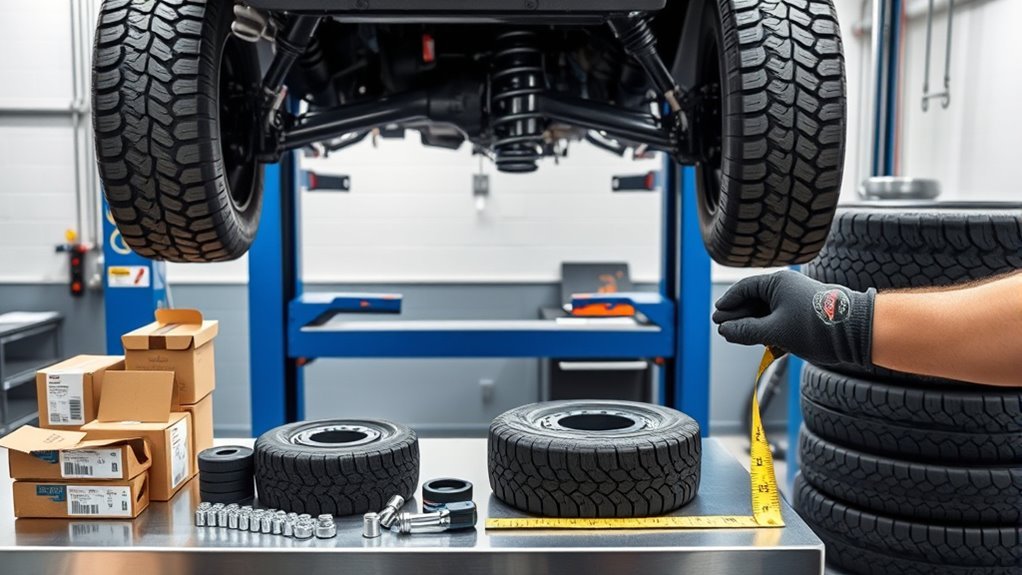
Lifting a Jeep Wrangler can be a small appearance upgrade or a full suspension project that changes tires, steering, driveline angles, and handling. The kit price is only the starting point. Your Wrangler generation, trim, engine, door count, axle setup, tire goal, and intended use determine the real cost.
Quick Answer
A basic body or spacer lift can cost about $100–$500 in parts, while a complete 2- to 3.5-inch suspension system often costs $1,000–$4,500 before labor. A realistic installed Wrangler project runs about $1,500–$7,500; builds with 35- or 37-inch tires, gears, driveshafts, steering, and brakes can exceed $10,000.
Key Takeaways
- Small lifts are inexpensive, but a complete trail-ready build can cost several times more than the lift kit itself.
- Fitment must match the exact Wrangler generation, two- or four-door body, engine, trim, axle width, fenders, and tire size.
- Alignment, wheels and tires, tire-size calibration, steering correction, driveshafts, brake hoses, and re-gearing may be required.
- An aftermarket lift does not automatically erase the entire vehicle warranty, but damage caused by a modification may be excluded.
- A quality 2- to 2.5-inch system is usually the best balance for a daily-driven Wrangler that also sees moderate trails.
At a Glance
| Time Required | About 2–4 hours for a simple spacer or body lift; roughly 6–10+ hours for a complete suspension system, plus alignment and road testing |
| Difficulty | Moderate for a small bolt-on lift; advanced for coil, control-arm, long-arm, steering, brake, or driveline work |
| Tools Needed | Rated floor jack and stands, wheel chocks, torque wrench, sockets and hand tools, penetrating oil, and any kit-specific tools listed by the manufacturer |
| Cost | About $100–$4,500+ for the kit; roughly $500–$10,000+ for a completed project depending on labor, tires, gears, steering, brakes, and driveline needs |
How Much Does It Cost to Lift a Jeep Wrangler?
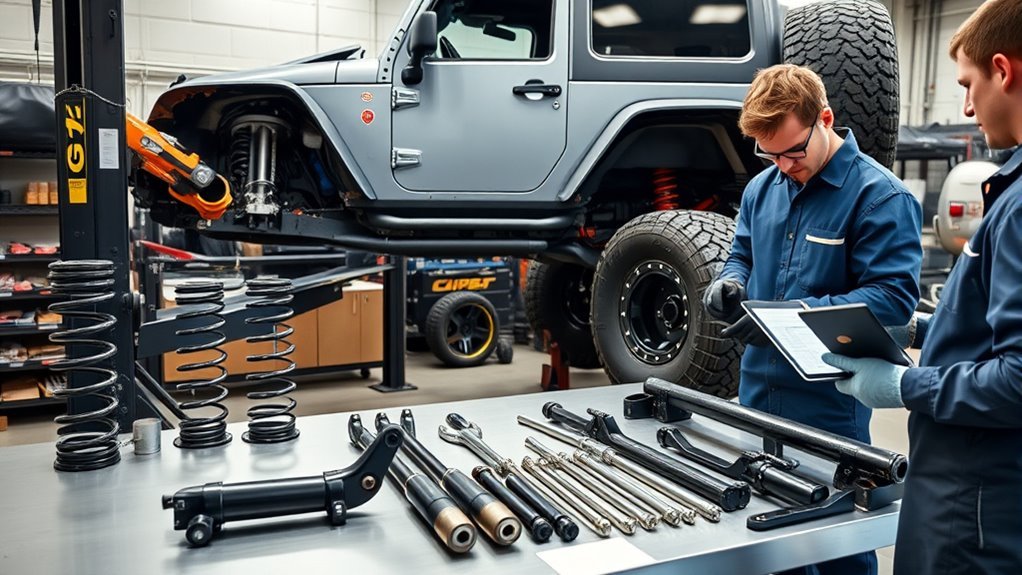
The price range is wide because “lifting a Wrangler” can mean very different things. A body lift may use little more than spacers and hardware. A complete suspension system may include springs, shocks, control arms, track-bar correction, bump stops, sway-bar links, brake-hose provisions, and steering parts.
Current manufacturer pricing shows the spread. A Wrangler JL body-lift kit can sell for under $100, while an official Mopar 2-inch suspension kit has been listed near a $2,000 MSRP. More complete 2.5-inch systems from specialist manufacturers can cost roughly $1,200 without shocks or more than $3,000 when configured with additional components. Prices change, so use these as current market examples rather than permanent quotes.
| Build level | Typical kit budget | Typical completed-project budget | Common goal |
|---|---|---|---|
| Body lift or small spacer lift | $100–$500 | $500–$1,500 before new tires | Appearance, mild clearance, or correcting rake |
| 2- to 2.5-inch street/trail suspension | $800–$2,500 | $1,800–$5,000 | Daily driving, 33- to 35-inch tire planning, moderate trails |
| 2.5- to 3.5-inch complete suspension | $1,500–$4,500+ | $4,000–$10,000+ | 35-inch tires, more articulation, frequent trail use |
| 4-inch or larger / 37-inch-plus build | $3,000–$7,000+ | $8,000–$20,000+ | Hard trails, rock crawling, major driveline and steering work |
These are planning ranges, not guaranteed quotes. Labor rates, rust, seized hardware, shipping, taxes, wheel count, tire brand, axle type, and the amount of corrective work can move the final price sharply.
The lift kit is often less than half the cost of a properly finished 35- or 37-inch-tire build.
Confirm Your Wrangler Before Buying a Lift
Do not shop by “Jeep Wrangler” alone. Confirm the model year, generation, body style, powertrain, trim, and axle setup before comparing prices. A kit for a two-door JK may not fit a four-door JL. A system designed for a gasoline JL may use different spring rates or parts than a Wrangler 4xe or Rubicon 392.
- Generation: YJ (1987–1995), TJ (1997–2006), JK (2007–2018), or JL (2018–present).
- Body: Two-door or four-door Unlimited.
- Powertrain: Engine and transmission, including 4xe or 392 where applicable.
- Trim and axles: Sport, Sahara, Willys, Rubicon, Rubicon X, factory wide-track axles, and factory tire package.
- Existing equipment: Steel bumpers, winch, roof rack, drawers, spare-tire carrier, or other weight that may change spring needs.
- Tire goal: Actual mounted tire diameter, wheel width, backspacing, load rating, and spare-tire plan.
Use the VIN and the official Mopar vehicle-information tools to verify the vehicle before ordering. Then read the kit’s complete fitment notes and installation instructions. Product listings often contain exclusions for manual transmissions, bumper types, engines, axle widths, or specific model years.
Note: A 4xe needs a kit specifically approved for its weight and configuration. Keep all work away from orange high-voltage cables and connectors, and follow the exact Wrangler 4xe owner and service information. High-voltage repairs belong with trained technicians.
Which Lift Kit Fits Your Needs?
Body Lift
A body lift raises the body from the frame with spacers. It can create more tire clearance without replacing the suspension springs, so the factory spring rate and basic suspension travel remain. It is usually the lowest-cost option, but it does not raise the frame, axles, or differential housings. Check bumper, shifter, cooling-fan, fuel-filler, wiring, and manual-transmission restrictions in the kit instructions.
Spacer or Budget Boost
A suspension spacer sits above or below the coil spring and raises the vehicle while keeping the original springs. This is a common low-cost choice for a mild lift. It can work well for appearance and light trail use, but shocks, bump stops, sway-bar links, caster, axle position, and brake-hose travel still need to match the new height.
Coil-Spring or Complete Suspension Lift
A coil-spring kit replaces the springs and may include longer shocks. A complete system adds the geometry-correction parts needed to keep the axles centered and the Jeep stable. For a daily-driven Wrangler that sees moderate trails, a well-engineered 2- to 2.5-inch complete system is usually a better long-term value than a cheap kit followed by piecemeal corrections.
Hybrid and Long-Arm Systems
A hybrid build combines suspension and body lift. It can limit how much suspension height is needed for a tire goal, but all parts must work together. Long-arm systems relocate control-arm mounting points to improve geometry and articulation at larger lift heights. They cost more, may require cutting or welding, and are best for dedicated trail builds rather than a simple daily-driver upgrade.
Pro Tip: Compare what each kit includes, not only the advertised lift height. A higher-priced system that includes shocks, control arms, track-bar correction, bump stops, sway-bar links, and brake-hose provisions may cost less than upgrading an incomplete kit later.
Lift Costs by Height
Lift height affects more than the springs. As height increases, caster, pinion angle, axle position, roll center, brake-hose length, driveshaft travel, bump-stop length, and steering behavior become more important.
| Lift height | Parts budget | What to expect |
|---|---|---|
| 1–1.5 inches | $100–$600 | Body lift or mild spacer lift; simplest installation, but fitment restrictions still apply |
| 2–2.5 inches | $600–$2,500+ | Common daily-driver and trail range; alignment, shocks, bump stops, caster, axle centering, and wheel clearance must be checked |
| 3–3.5 inches | $1,200–$4,500+ | More geometry correction; control arms, track bars or brackets, driveshaft clearance, brake hoses, and steering become major budget items |
| 4 inches or more | $2,500–$7,000+ | Large-build territory; long-arm parts, driveshafts, steering correction, gears, axle upgrades, fenders, and braking work may be needed |
Actual lift can differ from the advertised number. A light two-door may sit higher than a loaded four-door using the same nominal spring. Heavy bumpers, a winch, a hardtop, tools, camping gear, and rear storage can reduce measured lift.
Professional Installation: Labor and Shop Charges
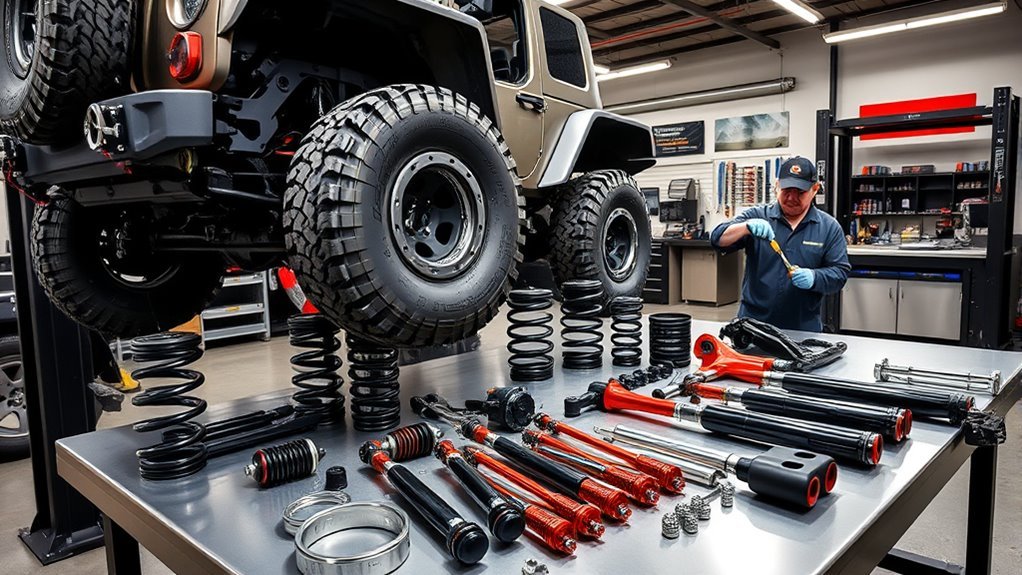
Simple lifts may take only a few hours. A complete suspension system can take most of a workday before alignment. For example, one current 2.5-inch JL four-door suspension system lists an estimated 7.5 hours without shocks and 8.5 hours with shocks. Rust, broken bolts, seized control-arm hardware, aftermarket bumpers, prior modifications, or custom fabrication add time.
A practical labor allowance is about $500–$2,500, but local shop rates and kit complexity control the final number. Ask for an itemized estimate that separates:
- Lift-kit installation labor
- Alignment and steering-wheel centering
- Tire mounting, balancing, and TPMS service
- Tire-size and gear-ratio calibration
- Brake-hose, driveshaft, exhaust, or skid-plate work
- Shop supplies, disposal fees, taxes, and diagnostic time
- Post-install inspection and any included re-torque visit
Choose a shop that regularly works on solid-axle Wranglers. Ask how it will set caster, center the axles, check bump-stop length, inspect brake hoses and ABS wiring at full droop and full steering lock, and verify driveshaft and exhaust clearance.
Warning: A shop name or “certified installer” label does not guarantee correct geometry or warranty coverage. Get the parts list, alignment targets, labor warranty, and responsibility for follow-up adjustments in writing.
Hidden and Recurring Costs
Alignment and Tracking
A suspension lift changes alignment angles and may shift the axles sideways. Budget about $120–$250 for a quality alignment in many markets, with more time possible when adjustable control arms or track bars must be set. The steering wheel should be centered, the axles should be positioned correctly, and caster and toe should be checked against the kit maker’s targets.
Recheck tire wear and steering after the first few hundred miles. A hard trail impact, bent steering part, or later height change can require another alignment.
Tires, Wheels, and the Spare-Tire System
A set of five larger tires can cost roughly $1,200–$3,000 or more. New wheels can add another $700–$2,500+, depending on size, construction, and whether they are beadlock-capable. Include mounting, balancing, TPMS sensors or service kits, shipping, and the full-size spare.
Large, heavy spares can overload the factory tailgate carrier. Depending on tire weight and size, you may need a reinforced hinge, relocation bracket, or bumper-mounted carrier. Also confirm that the factory jack can lift the modified Jeep safely; a jack extension or different recovery plan may be needed.
Driveshafts and U-Joints
There is no universal rule that every Wrangler lifted more than 2.5 inches must immediately receive new driveshafts. The need depends on generation, transmission, transfer case, actual lift, shock length, droop, pinion angle, exhaust clearance, and how the Jeep is used.
Inspect the front and rear driveshafts at ride height, full droop, and full compression. Watch for boot contact, joint bind, vibration, grease loss, torn boots, or contact with the exhaust or skid plates. A replacement shaft commonly adds several hundred to more than $1,000 per axle before labor.
Gears, Brakes, Steering, and Calibration
Larger tires change effective gearing and increase rotating mass. Some Wranglers remain acceptable on 33-inch tires with factory gearing; others feel sluggish with 35s or 37s, especially when towing, climbing grades, or using a high overdrive ratio. A front-and-rear re-gear is a major job, so a realistic planning allowance is often about $1,800–$3,500+, depending on axles, parts, lockers, bearings, and labor.
Steering upgrades may include an adjustable track bar, drag-link correction, tie rod, sector-shaft support, steering damper, or stronger ball joints. Choose parts to solve a measured problem; a steering damper should not be used to hide loose joints, poor caster, incorrect toe, or a damaged track bar.
Brake-hose length and routing must be checked through full suspension travel. Larger tires may also justify higher-friction pads, fresh rotors, or a larger brake package, but the correct solution depends on the vehicle and tire mass. After changing tire diameter or axle ratio, recalibrate supported vehicle settings so speed, shift behavior, odometer readings, and driver-assistance functions are as accurate as the vehicle allows.
How Lift Height Affects Tire Fitment
Lift height alone does not determine tire fitment. Fender design, bump stops, wheel backspacing, axle width, steering lock, tire width, actual measured tire diameter, and suspension travel all matter. A tire that clears while parked can still rub while turning, braking, or articulating on a trail.
Lift Height vs. Tire Diameter
- 31- to 33-inch tires: Often possible with stock height or a mild lift, depending on Wrangler generation, trim, wheel, and intended articulation.
- 35-inch tires: Commonly paired with about 2–3.5 inches of lift, but some factory configurations already offer 35-inch tires. Bump stops, wheel clearance, gearing, spare support, and steering load still matter.
- 37-inch tires: May fit some JL Rubicon combinations with a well-designed 2.5-inch system and the required bump stops, fenders, and wheel backspacing. Other trims or generations need more lift, high-clearance fenders, and much more supporting work.
- Larger than 37 inches: Usually requires a system-level build involving axles, steering, brakes, gearing, driveshafts, fenders, wheels, and body clearance—not simply taller springs.
Jeep lists available 35-inch tires on the 2026 Wrangler, which shows why a universal “X-inch lift equals Y-inch tire” chart is unreliable. Start with the factory configuration and the exact suspension manufacturer’s fitment instructions.
Wheel Backspacing and Clearance
Do not choose wheels from a generic offset chart. Follow the suspension and tire manufacturer’s required wheel width and backspacing. One current JL four-door 2.5-inch system, for example, calls for aftermarket wheels with 4.75 inches of backspacing or less and lists different bump-stop requirements for Sport/Sahara and Rubicon fenders.
After installation, check clearance at full left and right steering lock, with the suspension compressed and drooped. Inspect the sway bar, control arms, frame, shocks, fenders, brake hoses, ABS wires, and inner wheel wells. Then repeat the inspection after the first trail trip.
DIY vs. Independent Shop vs. Dealer
DIY Installation
DIY can save labor, but it requires a flat work area, rated lifting equipment, torque tools, safe spring handling, the complete instructions, and enough time to stop when something does not fit. A simple lift may take an experienced owner half a day. A first-time complete suspension install can take a full day or weekend, followed by professional alignment.
Independent 4×4 Shop
A capable independent shop is often the best balance of price and experience. Look for clear alignment practices, familiarity with your Wrangler generation, and a willingness to road-test and inspect the completed system rather than only bolt on parts.
Dealer Installation
A dealer may be useful for Mopar parts, vehicle-specific programming, and warranty documentation. Dealer installation usually costs more, and it does not guarantee that every future claim will be covered. Read the parts warranty, vehicle warranty, and labor terms.
Under federal warranty law, a company generally cannot require branded parts or authorized service as a blanket condition of warranty coverage, subject to limited exceptions. However, Jeep’s warranty information also warns that coverage may be restricted or denied when a vehicle or part has been modified and the warranty terms apply. In practice, the key question is whether the modification caused or contributed to the failure.
Budgeting for Safety and Performance
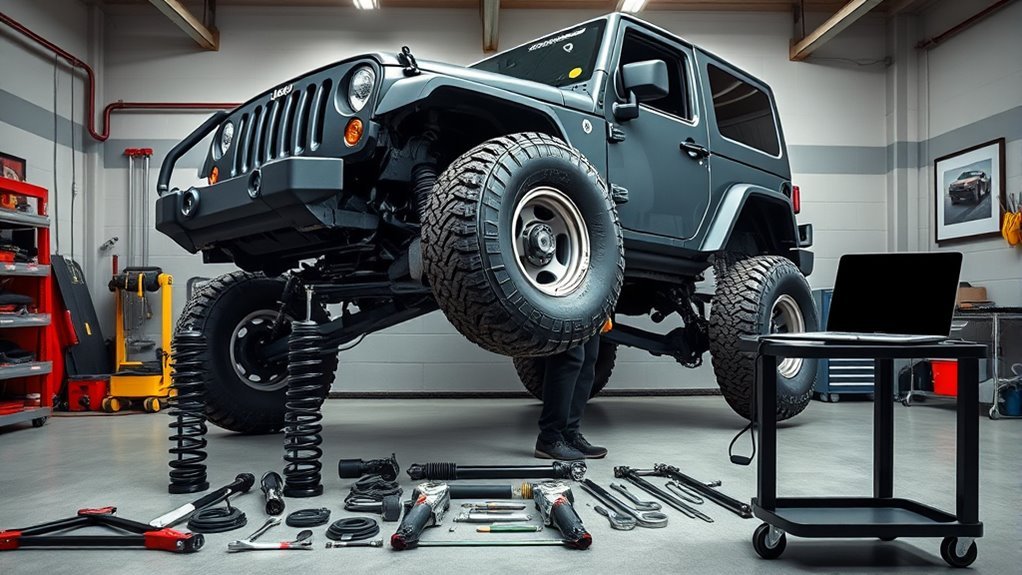
A lift changes the Wrangler’s center of gravity and can change steering feel, braking distance, body roll, and emergency response. The goal is not simply to make the Jeep taller. The finished vehicle should steer, brake, track, and articulate without binding or damaging nearby parts.
Before the first road drive, verify all of the following:
- Every fastener is torqued using the kit and factory procedures, with the suspension loaded where required.
- Brake hoses, ABS wires, breather hoses, parking-brake cables, and locker wiring have enough travel and cannot rub.
- Driveshafts, joints, exhaust, skid plates, shocks, coils, and sway-bar links clear through the usable travel range.
- The axles are centered, the steering wheel is straight, and toe and caster are set for the system.
- The tires clear at full steering lock and compression, and the bump stops prevent destructive contact.
- Tire pressure is set from a safe, vehicle-specific load calculation—not copied from the tire sidewall maximum.
- Headlamp aim, speedometer-related settings, TPMS operation, and driver-assistance warnings are checked.
- The Jeep completes a low-speed test, controlled road test, and follow-up inspection before highway or trail use.
Follow the kit maker’s re-torque and inspection schedule. Recheck the system after the initial break-in, after hard off-road use, and whenever steering feel, vibration, noise, or tire wear changes.
Warning: Never work beneath a Wrangler supported only by a hydraulic jack. Use wheel chocks and properly rated jack stands on a stable surface. Spring energy, vehicle weight, brake-system work, steering changes, welding, and 4xe high-voltage components can cause serious injury or death.
Legal, Insurance, Payload, and Towing Considerations
Lift, bumper, headlamp, fender-coverage, and tire rules vary by location. Check current state and local equipment rules before building a street-driven Wrangler. Tell your insurer about major suspension, tire, or value changes and keep invoices, alignment sheets, calibration records, and installation photos.
A lift does not increase the Wrangler’s GVWR, axle ratings, payload rating, or tow rating. Added bumpers, a winch, larger tires, wheels, a spare carrier, suspension parts, and trail gear consume available payload. Keep the installed tires within safe load and speed ratings, and review the driver-door Tire and Loading Information label and owner’s manual. NHTSA advises using the original tire size or another size recommended by the vehicle manufacturer when possible.
Towing with a lifted Wrangler may require a different ball mount to keep the trailer level. The higher center of gravity, heavier tires, changed gearing, and added accessories can also affect stability and braking. Stay within the vehicle’s ratings and use a qualified towing or chassis professional when the setup is uncertain.
Decision Checklist: Choose the Right Kit for Your Budget and Use
- Define the use: Daily driving, overlanding, moderate trails, or rock crawling.
- Choose the tire first: Set the real tire diameter, width, load rating, wheel specification, and spare plan.
- Verify the Jeep: VIN, generation, two- or four-door body, engine, transmission, trim, axles, fenders, and existing weight.
- Compare complete systems: List springs or spacers, shocks, control arms, track bars or brackets, bump stops, sway-bar links, brake provisions, and required wheel backspacing.
- Build the full budget: Kit, freight, tax, labor, alignment, five tires, wheels, TPMS, calibration, spare support, gears, driveshafts, steering, brakes, and inspection.
- Check documentation: Installation instructions, torque values, fitment exclusions, parts warranty, shop labor warranty, and vehicle warranty terms.
- Plan the final setup: Alignment targets, tire pressure, headlamp aim, calibration, road test, re-torque, and follow-up inspection.
For most daily-driven Wranglers, the best value is a modest, complete suspension system from a reputable manufacturer rather than the tallest kit available. Buy enough correction parts to make the Jeep drive properly, and leave room in the budget for the upgrades discovered during inspection.
Frequently Asked Questions
How much does it cost to lift a Jeep Wrangler?
A basic body or spacer lift may cost about $100–$500 in parts. A complete suspension system commonly costs $1,000–$4,500+ before labor. An installed project with alignment often runs $1,500–$7,500, while tires, gears, steering, driveshafts, and brakes can push a 35- or 37-inch build past $10,000.
Does a lift kit void a Jeep warranty?
Not automatically. Federal warranty rules generally prevent blanket requirements that owners use only branded parts or authorized service, subject to limited exceptions. However, a manufacturer may deny coverage for damage caused or contributed to by the lift, larger tires, improper installation, or related modifications. Keep records and read the exact warranty.
How long does it take to lift a Jeep?
A simple spacer or body lift may take about 2–4 hours. A complete suspension system often takes 6–10+ hours, depending on the kit and vehicle condition. Alignment, calibration, tire work, rust, broken hardware, or custom fabrication add time.
What lift is best for 35-inch tires?
Many Wranglers use about 2–3.5 inches of lift for 35-inch tires, but there is no universal answer. Generation, trim, fenders, wheel backspacing, bump stops, axle width, tire width, and trail articulation determine the correct system. Some current Wrangler configurations offer 35-inch tires from the factory.
Do larger tires require re-gearing?
Not always, but the chance rises with tire diameter and weight. Engine, transmission, factory axle ratio, elevation, towing, and driving expectations matter. Re-gearing both axles can restore acceleration, shift behavior, crawl control, and drivability when the factory ratio is no longer suitable.
Can you lift a Wrangler 4xe or Rubicon 392?
Yes, but use a kit specifically listed for that model, engine, and year. The 4xe and 392 have different weight and packaging needs, and some kits have unique springs, shocks, brackets, or exclusions. For a 4xe, keep work away from orange high-voltage components and use qualified help when service procedures involve the electrified system.
Conclusion
Lifting a Jeep Wrangler is a system upgrade, not a single purchase. A small body or spacer lift can be inexpensive, but a well-finished suspension build must account for alignment, tires, wheels, bump stops, steering, brakes, driveshafts, gears, calibration, payload, and warranty terms. Match the kit to the exact Wrangler and the way it will be used. A lower, complete, properly aligned build is usually safer, more reliable, and better to drive than a taller bargain kit with missing correction parts.
Sources
- Official Mopar eStore — Wrangler and Gladiator 2-inch lift kits — current OEM kit design and pricing context.
- Jeep — 2026 Wrangler capability — factory 35-inch tire availability and current Wrangler capability information.
- Mopar — Current model-year warranty coverage — modification-related warranty language and vehicle-specific warranty access.
- Federal Trade Commission — Warranty warnings and the Magnuson-Moss Act — limits on blanket branded-parts and authorized-service requirements.
- NHTSA TireWise — tire-size, placard, inflation, and replacement-tire safety guidance.
- TeraFlex — JL four-door 2.5-inch Sport ST2 system — manufacturer fitment, labor-time, wheel-backspacing, bump-stop, and alignment requirements.





Leave a Reply