
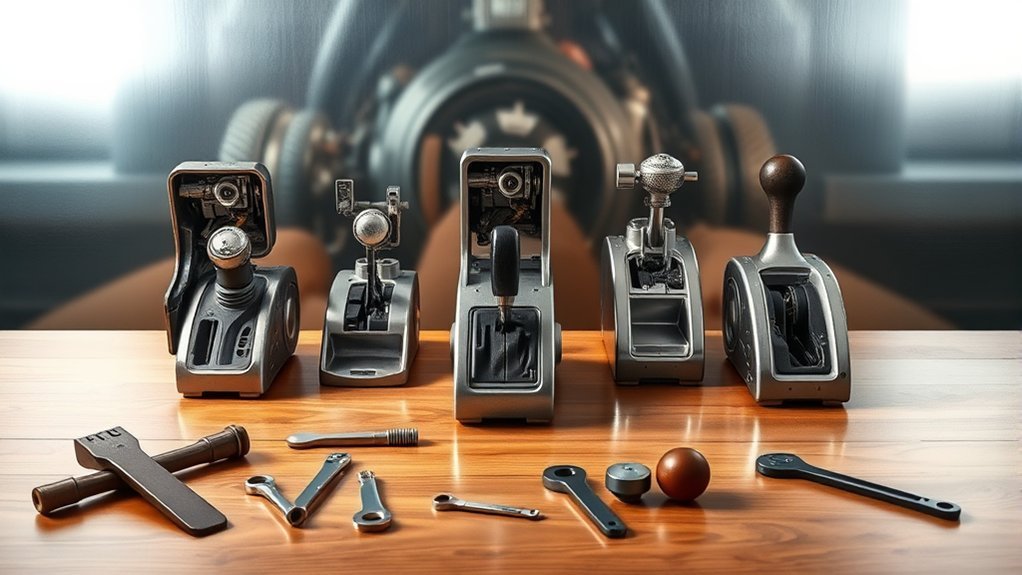
Manual transmissions helped shape the automobile, but their story is more complex than simply adding more gears. Early drivers wrestled with sliding gears and had to match shaft speeds by feel. Synchromesh later made shifting easier, while overdrive ratios, stronger materials, and electronic aids improved performance. Today, the manual gearbox survives mainly because some drivers still value direct control and involvement.
Quick Answer
Manual transmissions developed from crude sliding-gear boxes in the 1890s to synchronized, five-speed, and six-speed designs with electronic rev matching. Synchromesh made shifting easier, while added ratios improved flexibility and cruising. Today, manuals remain valued for driver involvement, but modern automatics and electrified powertrains have reduced them to a small niche.
Key Takeaways
- Early sliding-mesh gearboxes required careful clutch and throttle control because their gears did not synchronize themselves.
- Cadillac’s Synchro-Mesh transmission for the 1929 model year was a major step toward easier, quieter shifting.
- Five- and six-speed gearboxes added closer ratios for acceleration and taller ratios for quieter highway cruising.
- A manual is not automatically more fuel-efficient, cheaper to maintain, or more reliable than a modern automatic.
- EPA data show that manuals have accounted for less than 1% of new U.S. vehicle production since model year 2021.
How a Manual Transmission Works
A manual transmission lets the driver choose the gear ratio. In a typical gasoline-powered car, the engine turns the transmission through a clutch. Pressing the clutch pedal separates the engine from the gearbox long enough for the driver to select another gear.
Inside the gearbox, different gear pairs provide different ratios. Low gears multiply torque for starting and acceleration. Higher gears reduce engine speed at a given road speed. Reverse normally uses an additional gear or a separate gear path to change the direction of the output shaft.
In most modern manuals, the forward gears remain in constant contact with their matching gears. Moving the shift lever does not slide the main gears into one another. Instead, it moves a selector sleeve that locks the chosen gear to its shaft.
A synchronizer uses friction surfaces to bring the gear and shaft to nearly the same speed before their teeth engage. This reduces gear clash and allows smoother shifts. Early sliding-mesh transmissions lacked that assistance, so the driver had to coordinate the clutch, engine speed, and road speed much more carefully.
Note: A dual-clutch transmission may contain gearsets that resemble those in a manual, but computers and actuators operate its clutches and shifts. It is therefore classified as an automatic or automated transmission from the driver’s point of view.
Manual Transmission History at a Glance
| Period | Development | Why It Mattered |
|---|---|---|
| 1890s | Panhard and Levassor helped establish the front-engine, rear-drive layout with a clutch and sliding-gear transmission. | The arrangement became an influential blueprint for early automobiles. |
| 1929 model year | Cadillac and LaSalle introduced Synchro-Mesh shifting. | Synchronizing gear speeds reduced clash and made shifting easier. |
| 1930s–1960s | Constant-mesh and partly or fully synchronized gearboxes spread across more vehicle classes. | Manual driving became less demanding, though some cars still lacked synchronization in first gear. |
| 1967 | Volkswagen documented a fully synchronized gearbox for the Beetle 1200, while the limited-production Alfa Romeo 33 Stradale used six forward speeds. | Full synchronization improved everyday use, while six speeds showed what was possible in a high-performance road car. |
| 1970s–1980s | Five-speed manuals became common in many passenger and performance cars. | An extra ratio could improve acceleration spacing or provide an overdrive gear for highway travel. |
| 1990s–2000s | Six-speed manuals spread through sports cars and then into a wider range of vehicles. | More ratios helped engines stay closer to their useful power range without sacrificing relaxed cruising. |
| 2010s–2020s | Electronic rev matching, hill-start assistance, shift indicators, and other driver aids appeared. | Technology made some manual cars easier to drive while retaining a clutch pedal and driver-selected gears. |
| Since MY 2021 | Manuals have remained below 1% of new U.S. light-duty vehicle production. | The gearbox has shifted from a mainstream choice to a specialized enthusiast feature. |
Early Manual Transmissions: The 1890s to the 1920s
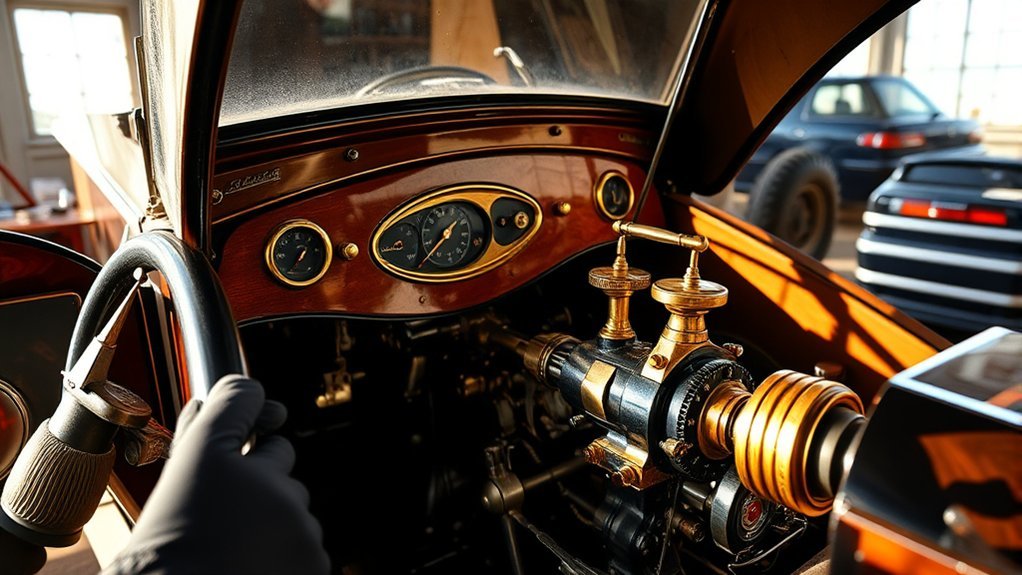
As the automobile took shape in the 1890s, engineers needed a practical way to transfer power from an engine that worked best within a limited speed range. Panhard and Levassor helped establish an influential layout that placed the engine at the front and sent power to the rear wheels through a clutch and transmission.
The company’s early Système Panhard used a sliding-gear design. To change ratios, the driver moved gears or gear elements into different positions. The parts did not automatically match their speeds before engagement.
That made shifting a learned mechanical skill. The driver had to release engine torque with the clutch, select the next ratio, and bring the engine and gearbox close to the correct speeds. A poorly timed shift could produce grinding, refuse to engage, or place unnecessary stress on the gear teeth.
Drivers often used double-clutching. During a shift, they released the clutch in neutral and adjusted engine speed before pressing the clutch again and selecting the next gear. This technique helped align shaft speeds in gearboxes that lacked synchronizers.
How Synchromesh Changed Gear Shifting
The most important early improvement was the synchronizer. Instead of asking the driver to match the speeds perfectly, the transmission used friction to bring the selected gear and shaft into alignment before engagement.
Cadillac developed its system during the 1920s and introduced the Synchro-Mesh Silent-Shift transmission for the 1929 model year. Cadillac described it as a system that eliminated gear clash during shifting.
Synchromesh did not make the gearbox automatic. The driver still operated the clutch and selected each ratio. What changed was the amount of precision required. Normal shifts became quieter and more forgiving, which helped make manual cars practical for a broader group of drivers.
Adoption was gradual. Some transmissions synchronized only their higher forward gears. First gear often remained unsynchronized because drivers normally selected it while stopped. Fully synchronized forward gearsets became more common over time, but the date varied by manufacturer, model, and market.
Synchromesh did not remove the driver from the process. It removed much of the gear-speed matching that made early manual transmissions difficult to shift cleanly.
From Fully Synchronized Gearboxes to Five and Six Speeds
By the middle of the 20th century, constant-mesh designs and synchronizers were common in passenger vehicles, although equipment still varied. Volkswagen’s historical archive notes that the Beetle 1200 had a fully synchronized gearbox by 1967.
More gears did not automatically make a transmission better, but they gave engineers more freedom. A lower first gear could help a car pull away, closely spaced middle ratios could support acceleration, and a taller top gear could reduce engine speed during steady cruising.
Why Five-Speed Manuals Became Popular
Three- and four-speed manuals were sufficient when engines had broad operating ranges and highway speeds were lower. As fuel economy, noise, and performance became more important, a fifth ratio offered useful flexibility.
In many vehicles, fifth gear functioned as overdrive. The transmission output could turn faster than its input, allowing the engine to run at a lower speed on the highway. This could reduce noise and fuel use without making the lower gears too tall for normal acceleration.
Five-speed manuals became common across many vehicle classes during the 1970s and 1980s. They were used in economy cars, family vehicles, trucks, and sports cars rather than belonging to one single category.
The Move to Six-Speed Gearboxes
The 1967 Alfa Romeo 33 Stradale is an important early example of a road car with six forward speeds. However, it should not be described as a mass-market model. The Museo Alfa Romeo records only 18 chassis.
Six-speed manuals became much more visible in production sports cars during the late 1980s and 1990s. They later appeared in less exotic vehicles. Depending on the design, the sixth ratio could provide closer performance gearing, a taller cruising gear, or a combination of both.
Modern Manual Transmission Technology
A modern manual still requires the driver to operate a clutch and select gears, but supporting technology can make the process smoother and protect the drivetrain.
Electronic Rev Matching
During a downshift, engine speed must rise to match the lower gear. Traditionally, a skilled driver used the accelerator while braking or while the clutch was disengaged. Electronic rev matching can briefly open the throttle to perform much of that speed adjustment automatically.
For example, Ford offers a six-speed manual with rev matching on current Mustang configurations. The driver still chooses the gear and operates the clutch, but the engine-control system helps smooth the downshift.
Hill-Start and Shift Assistance
Hill-start assistance can hold the brakes briefly as the driver moves from the brake pedal to the accelerator. This reduces rollback but does not replace proper clutch control.
Some vehicles also use shift indicators, selectable rev-matching modes, anti-stall programming, or no-lift-shift logic. These features depend on the exact model and should not be assumed to be present on every modern manual car.
Clutch and Material Development
Modern clutch discs, friction materials, synchronizers, bearings, lubricants, and gear-manufacturing methods can handle more power in a smaller package than many early designs. Performance vehicles may use twin-disc or other multi-plate clutch assemblies to increase torque capacity without requiring one very large disc.
These assemblies are part of the clutch system rather than proof that every modern manual transmission uses multiple clutches. Most ordinary manual cars still use one driver-operated clutch assembly.
Advantages and Tradeoffs of Manual Transmissions
Manual transmissions remain appealing because the driver chooses when each shift occurs. That can create a stronger sense of involvement, especially on a winding road, a racetrack, or in a vehicle designed around a light and direct control layout.
| Factor | Possible Advantage | Important Limitation |
|---|---|---|
| Driver control | The driver can hold or select a ratio without waiting for automatic shift logic. | Many automatics also offer effective manual-selection modes. |
| Engagement | Clutch and shift inputs can make driving feel more interactive. | The same workload can become tiring in congestion or on steep hills. |
| Mechanical layout | Some manuals are lighter and mechanically simpler than a comparable conventional automatic. | Modern manuals may still use complex electronics, dual-mass flywheels, and expensive components. |
| Purchase and repair cost | A manual may cost less in certain vehicles and can avoid some automatic-transmission components. | Low production volume, clutch replacement, and scarce parts can erase the savings. |
| Fuel economy | Older manuals often avoided the losses and limited gear counts of older automatics. | Modern automatics are often equally or more efficient and may have eight, nine, or ten ratios. |
| Performance | The driver controls the timing and character of each shift. | Fast modern automatics and DCTs usually shift more quickly than a person can. |
Pro Tip: Compare the official fuel-economy ratings, performance figures, warranty terms, and service schedule for the exact manual and automatic versions you are considering. The result can differ even between two trims of the same model.
Why Manual Transmissions Are Losing Popularity
Manuals are no longer disappearing merely because drivers prefer convenience. Their decline reflects changes in vehicle engineering, emissions testing, traffic conditions, manufacturing costs, and powertrain design.
The EPA’s 2025 Automotive Trends Report, published in February 2026, says manuals appeared in almost 35% of new vehicles in model year 1980. They have remained below 1% of new U.S. light-duty vehicle production since model year 2021.
Manual transmissions fell from almost 35% of new U.S. vehicles in model year 1980 to less than 1% of production in every model year since 2021, according to the EPA.
- Modern automatics have more ratios. The EPA reports that the average automatic surpassed the average manual in gear count in model year 2012.
- Automatics can shift faster. DCTs and performance automatics can change gears without the interruption and human reaction time of a conventional clutch-pedal shift.
- Efficiency is no longer a clear manual advantage. Lockup torque converters, additional gears, improved controls, and hybrid integration have reduced or reversed the old fuel-economy gap.
- Traffic favors two-pedal operation. Constant clutch use can be tiring in slow urban congestion.
- Low demand raises production costs. Engineering, certifying, stocking, and servicing a separate transmission becomes harder to justify when few buyers select it.
- Fewer people learn to drive one. Limited availability reduces training opportunities, which further reduces demand.
- Electrification changes the hardware. Most battery-electric vehicles use a single-speed reduction gear rather than a conventional manual transmission.
Manual vs. Automatic, DCT, CVT, and EV Drivetrains
| Type | How It Changes Ratio | Driver Input |
|---|---|---|
| Traditional manual | Driver-selected gears with a manually operated clutch. | Clutch pedal and gear lever. |
| Torque-converter automatic | Planetary gearsets or other automatic gear arrangements controlled hydraulically and electronically. | Usually accelerator and brake only; manual-selection modes may be available. |
| Dual-clutch transmission | Two automated clutches manage alternating gearsets. | No clutch pedal; computer-controlled automatic or paddle shifting. |
| Automated manual | Actuators operate a conventional-style clutch and gear mechanism. | No clutch pedal; shifts are commanded automatically or by the driver. |
| CVT | Continuously varies its ratio within a designed range rather than using fixed gears in the traditional sense. | Normally accelerator and brake only; simulated steps may be offered. |
| Battery-electric drive | Usually uses one fixed reduction ratio because an electric motor works across a broad speed range. | Accelerator and brake; no conventional clutch pedal or manual gearset. |
Will Manual Transmissions Disappear?
Manuals are unlikely to return as the default transmission for ordinary new cars. Automatic systems now fit more easily with adaptive cruise control, hybrid operation, driver-assistance features, emissions strategies, and stop-and-go traffic.
However, complete disappearance is not certain. A small group of manufacturers continues to offer manuals in vehicles built around driver involvement. The gearbox can also help distinguish an enthusiast model from a mechanically similar automatic version.
Its future is likely to be narrow rather than nonexistent. Manuals may remain available in selected sports cars, performance hatchbacks, off-road vehicles, and specialty models while disappearing from most family cars and crossovers.
Electric vehicles present the largest long-term challenge. Their motors usually do not need the multiple fixed ratios or disconnect clutch used by combustion-engine cars. Some future vehicles may imitate manual shifting through software, sounds, or driver controls, but a simulated shift system is mechanically different from a traditional manual gearbox.
Maintenance and Driving Basics
A manual transmission can last a long time, but its life depends on its design, lubricant, clutch condition, driving style, vehicle load, and service history.
- Follow the exact maintenance schedule. Use the fluid specification and interval listed for the vehicle’s model year, engine, gearbox, and market.
- Do not rest your foot on the clutch pedal. Even light pressure may keep the release mechanism partly loaded.
- Avoid holding the car on a hill with clutch slip. Use the brakes or parking brake rather than turning the clutch into a holding device.
- Do not force a resistant shift. Grinding, refusal to enter gear, or a sudden change in shift effort needs diagnosis.
- Watch for leaks. Low lubricant can damage gears, synchronizers, and bearings.
- Investigate clutch symptoms. Slipping under load, shuddering, unusual noise, a changing pedal feel, or difficulty selecting gears may signal a clutch, hydraulic, cable, mount, or transmission problem.
Warning: Learn clutch control only in a legal, open practice area with an experienced instructor. Do not practice starts, hill holding, rev matching, or emergency maneuvers in traffic. Stop driving if the clutch fails to disengage, the vehicle moves unexpectedly, or the transmission produces severe grinding or banging.
Frequently Asked Questions
What are the main differences between manual and automatic transmissions?
A traditional manual requires the driver to operate a clutch and choose each gear. An automatic controls ratio changes without a clutch pedal. Modern automatics may use a torque converter, dual clutches, a continuously variable mechanism, or another electronically controlled design. Many also let the driver request gears through a lever or paddles.
How do I properly maintain a manual transmission?
Use the lubricant and service schedule specified by the vehicle manufacturer. Check for leaks and investigate grinding, bearing noise, clutch slip, shudder, a changing pedal feel, or difficulty engaging gears. Avoid assuming that every manual needs fluid replacement at the same mileage because the requirements vary by design and use.
Can I convert an automatic car to a manual transmission?
A conversion is technically possible on some vehicles, especially when a factory manual version used the same platform. The work may require a transmission, clutch, flywheel, pedals, hydraulics, shifter, mounts, axles, wiring, control-module programming, interior parts, and instrument changes. Safety systems, emissions compliance, inspection rules, resale value, and insurance should be checked before starting. In many cases, buying a factory-built manual car costs less.
Which vehicles still offer manual transmissions?
In the United States, official 2026 information confirms manual configurations for vehicles including the Mazda MX-5 Miata, Ford Mustang, and Toyota GR Corolla. Availability depends on trim, engine, body style, market, and production timing, so confirm the current configuration before ordering.
Which driving techniques are important in a manual car?
Start with smooth clutch engagement, light accelerator input, and unhurried shifts. Learn the clutch’s engagement point in a safe practice area. Release the clutch fully after each shift, choose a suitable gear before entering a turn, and use the brakes rather than prolonged clutch slip to control the car on a hill. Advanced techniques such as heel-and-toe downshifting should come later.
Are manual transmissions always more fuel-efficient?
No. Manuals often had an efficiency advantage over older automatics because those automatics had fewer gears and greater torque-converter losses. Modern automatics use lockup clutches, additional ratios, and advanced controls. The EPA says they are now generally more efficient and can provide better performance than manuals. Compare the official ratings for the exact vehicle.
Conclusion
The history of manual transmissions is a progression from difficult mechanical gear changes to precise, synchronized systems supported by modern electronics. Sliding gears demanded considerable skill, Synchro-Mesh reduced gear clash, and additional ratios improved performance and cruising flexibility.
Manuals no longer hold an automatic advantage in fuel economy, speed, cost, or reliability. Their strongest remaining benefit is the experience they provide. For drivers who enjoy coordinating the clutch, throttle, and shifter, that direct involvement can still make a manual car worth choosing—even as the market around it becomes smaller.
Sources
- Audrain Auto Museum — 1901 Panhard et Levassor Type B1 — early Système Panhard layout and transmission history.
- Cadillac 120th Anniversary Historical Timeline — 1929 Synchro-Mesh milestone.
- Volkswagen Newsroom — Beetle 1200 History — fully synchronized Beetle gearbox documentation.
- Museo Alfa Romeo — 33 Stradale Prototype — six-speed specification and limited production total.
- U.S. Environmental Protection Agency — 2025 Automotive Trends Report — transmission production share, gear-count trends, and modern efficiency comparison.
- Mazda MX-5 Miata, Ford Mustang, and Toyota GR Corolla — official 2026 manual-transmission availability examples.







Leave a Reply