
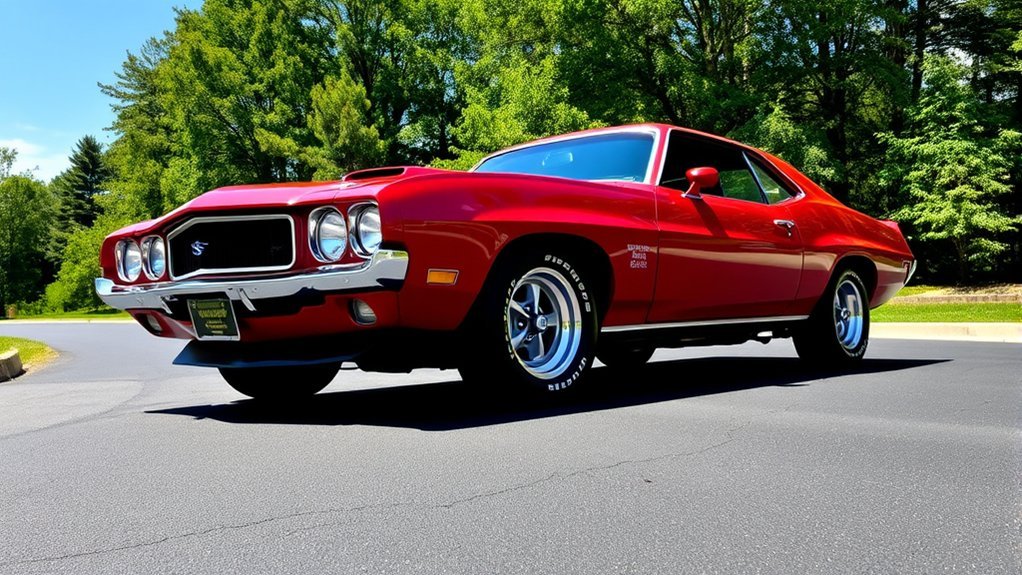
The muscle car era changed American car culture by putting large-engine performance into vehicles that ordinary buyers could recognize and, at least when new, often afford. Its roots reach back to cars such as the 1949 Oldsmobile Rocket 88, while the 1964 Pontiac GTO established the formula that fueled the golden age. Later generations added fuel injection, computer controls, advanced suspension, turbocharging, and electric power.
Quick Answer
The classic muscle car era is usually placed from the mid-1960s through the early 1970s. It centered on relatively affordable American cars with powerful engines and strong straight-line performance. The Pontiac GTO helped establish the formula, while later Mustangs, Camaros, Chargers, and other performance cars expanded it.
Key Takeaways
- The 1949 Oldsmobile Rocket 88 was an important precursor, but the title of “first muscle car” remains debated.
- The 1964 Pontiac GTO is widely credited with turning the big-engine, affordable-performance formula into a distinct market segment.
- Classic horsepower figures were usually measured under SAE gross standards and should not be compared directly with modern SAE net ratings.
- Emissions rules, insurance costs, fuel changes, and the 1973 oil embargo all contributed to the early-1970s decline.
- By 2026, the category includes V8 pony cars, turbocharged six-cylinder Chargers, and an electric Charger, showing how much the definition has expanded.
What Defines a Muscle Car?
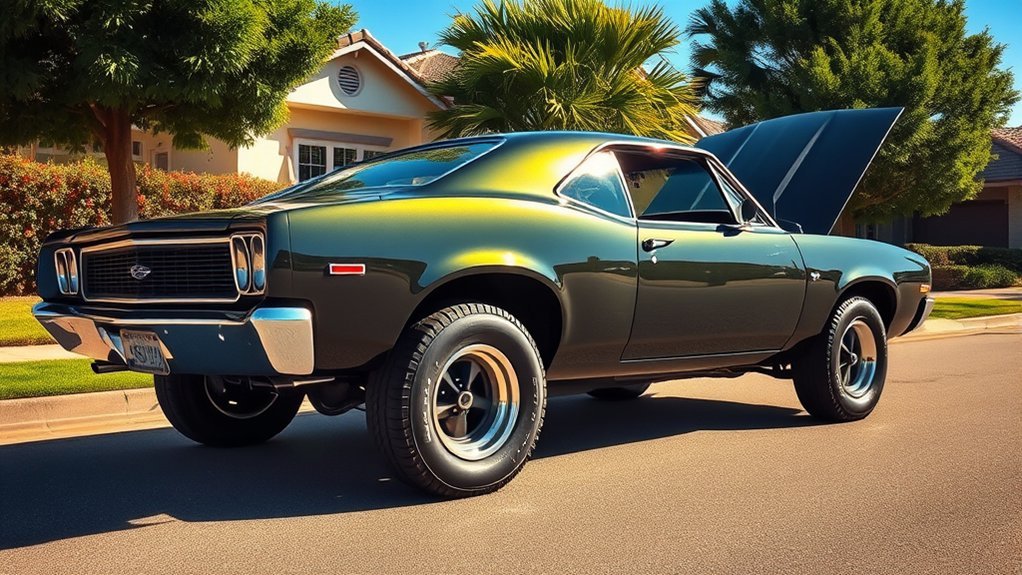
There is no legal or universally accepted definition of a muscle car. Traditionally, the term describes an American vehicle that combines a relatively ordinary production body with a powerful engine, rear-wheel drive, aggressive styling, and an emphasis on acceleration.
The classic formula often included:
- A large-displacement V8 engine
- A two-door coupe, hardtop, or sedan body
- Rear-wheel drive
- Strong straight-line acceleration
- A price below that of an exotic or dedicated sports car
- Upgraded suspension, brakes, transmission, tires, or rear axle
- Styling that distinguished the performance version from the base model
Not every car called a muscle car meets all of those conditions. Some early models had four doors, and modern performance cars may use six-cylinder engines or electric motors. The term has therefore become broader with time.
Note: “Muscle car” is a historical and cultural category rather than a precise engineering class. Enthusiasts may reasonably disagree about individual models.
Muscle Cars vs. Pony Cars and Sports Cars
The Ford Mustang created the pony-car category: compact, stylish, relatively affordable cars with long hoods, short rear decks, and a wide choice of engines. The Chevrolet Camaro, Pontiac Firebird, Plymouth Barracuda, and Dodge Challenger followed the same basic concept.
High-performance pony cars such as the Mustang 428 Cobra Jet and Camaro ZL1 are commonly included in muscle-car discussions. Strictly speaking, however, the body class and market position differ from traditional midsize muscle cars such as the Pontiac GTO, Chevrolet Chevelle SS, Plymouth Road Runner, and Dodge Charger R/T.
Purpose-built two-seat models such as the Shelby Cobra and Dodge Viper are better classified as sports cars. They share the muscle era’s focus on power and speed, but they were not ordinary passenger-car platforms fitted with higher-performance engines.
A Brief History of the Muscle Car Era
The roots of American muscle appeared before the term became common. The 1949 Oldsmobile 88 combined a relatively light body with a new 303-cubic-inch overhead-valve Rocket V8 rated at 135 horsepower. Its success in early stock-car racing helped establish the appeal of placing a strong engine in a lighter production car.
Calling the Rocket 88 the first muscle car is still a matter of interpretation. A clearer starting point for the recognized market segment is the 1964 Pontiac GTO. Offered as an option on the Pontiac Tempest LeMans, it paired a 389-cubic-inch V8 with a midsize body and an accessible base price. GM lists the standard four-barrel engine at 325 horsepower and the optional Tri-Power version at 348 horsepower.
| Year | Milestone | Why It Matters |
|---|---|---|
| 1949 | Oldsmobile Rocket 88 | An influential big-engine, lighter-body precursor rated at 135 gross horsepower. |
| 1964 | Pontiac GTO | Popularized the affordable midsize-car and large-V8 formula. |
| 1968 | Road Runner, Charger R/T, and Cobra Jet Mustang | Showed how the market had expanded from stripped-down value cars to stylish grand-touring models and pony cars. |
| 1970 | Chevelle SS 454 LS6 | Its factory-rated 450-gross-horsepower LS6 became a symbol of peak-era performance. |
| 1973 | Arab oil embargo | Fuel shortages and price increases accelerated demand for more efficient vehicles. |
| 1980s–1990s | Electronic-performance revival | Fuel injection, engine computers, overdrive transmissions, and improved chassis systems restored usable power. |
| 2000s | Retro-design revival | Mustang, Challenger, and Camaro reintroduced classic styling with modern safety and engineering. |
| 2020s | Multi-energy performance | The category expanded to include turbocharged six-cylinder and battery-electric powertrains. |
The period most often described as the golden age runs from the mid-1960s into the early 1970s. The exact ending year varies because new models, emissions changes, lower compression ratios, and revised horsepower measurements did not arrive at the same time.
Iconic Muscle Cars of the 1960s
The 1960s produced a wide range of performance cars, from affordable coupes with few luxury features to highly optioned fastbacks and hardtops.
The 1964 Pontiac GTO established the best-known early formula. Its 389-cubic-inch V8 was much larger than the engines normally associated with Pontiac’s midsize Tempest platform, while the option package included dual exhaust, upgraded suspension equipment, special badges, and hood scoops.
The 1968 Dodge Charger R/T combined dramatic fastback styling with a standard 440-cubic-inch Magnum V8 rated at 375 SAE gross horsepower. Buyers could also order the 426 Hemi, factory-rated at 425 gross horsepower.
The 1968 Plymouth Road Runner took a more basic approach. It offered bold branding and serious performance without requiring buyers to pay for every luxury feature. Its standard 383-cubic-inch V8 was factory-rated at 335 gross horsepower, while the 426 Hemi was optional.
The Ford Mustang 428 Cobra Jet brought big-block power to the pony-car market. Ford rated the 428 Cobra Jet at 335 gross horsepower, although period racers often believed that figure understated its potential.
The Shelby Cobra 427 Super Snake also became a symbol of extreme American performance. However, it was a lightweight two-seat sports car rather than a traditional production-based muscle car. Shelby American states that the Super Snake name first appeared on a big-block Cobra roadster in 1966.
The golden age was not defined by one body style or brand. Its common thread was the rapid spread of accessible factory performance across the American market.
The 1970s: A Turning Point for Muscle Cars
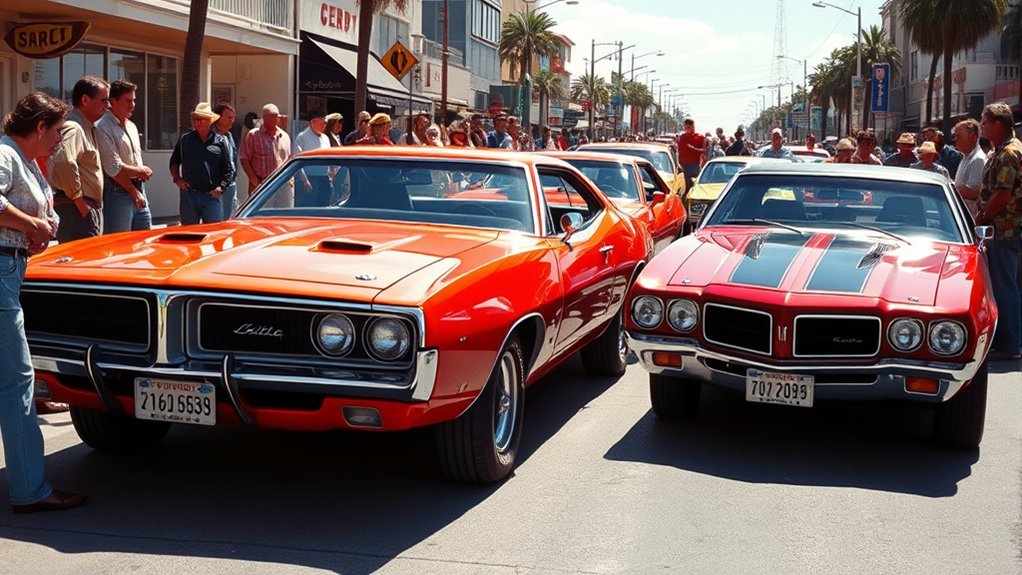
The original muscle-car boom did not end because of one law or event. Several economic, technical, and regulatory changes arrived within a few years.
- Emissions requirements: The Clean Air Act of 1970 established a stronger federal framework for controlling vehicle pollution. Manufacturers had to reduce hydrocarbons, carbon monoxide, and nitrogen-oxide emissions.
- Lower compression ratios: Engines were redesigned to operate on lower-octane unleaded gasoline and meet changing emissions requirements. This reduced the output of many familiar engine combinations.
- Insurance costs: Young drivers and high-output models could attract steep premiums, weakening the affordability that had helped create the market.
- Fuel shortages and prices: The 1973 Arab oil embargo contributed to gasoline shortages, station lines, and greater interest in smaller vehicles.
- Catalytic converters: Their widespread arrival during the 1975 model year required unleaded fuel and further changed exhaust and engine design.
- Changing buyer priorities: Fuel economy, comfort, safety, and emissions compliance became more important than maximum advertised output.
Why Horsepower Numbers Dropped So Quickly
The apparent performance collapse was partly caused by a change in measurement. Most 1960s ratings were stated as SAE gross horsepower, measured on an engine without the full production exhaust, accessory drive, air cleaner, and other installed equipment.
By the early 1970s, manufacturers had largely moved to SAE net horsepower, measured in a configuration closer to the engine as installed in the car. Real output also fell on many models, but the rating change made the numerical drop look even larger.
Note: A 1970 engine rated at 350 SAE gross horsepower is not directly equivalent to a modern engine rated at 350 SAE net horsepower.
How Muscle Cars Made a Comeback in the 1980s and 1990s
Performance began recovering during the 1980s, but manufacturers did not simply return to the high-compression engines of the previous era. They used electronics, improved fuel systems, and more efficient drivetrains to produce cleaner and more dependable power.
Performance Innovations
- Electronic fuel injection delivered more precise fuel control than a traditional carburetor.
- Computerized ignition and engine management improved drivability, cold starts, emissions control, and power delivery.
- Overdrive manual and automatic transmissions allowed strong acceleration with lower engine speed during highway driving.
- Improved aerodynamics helped reduce drag and increase high-speed stability.
- Better radial tires, brakes, and suspension tuning made performance more usable outside a straight line.
- Weight-conscious platforms allowed moderate engine output to produce competitive acceleration.
The Ford Mustang GT 5.0, Chevrolet Camaro Z28 and IROC-Z, and Pontiac Firebird Formula and Trans Am became central to the V8 revival. The turbocharged Buick Grand National demonstrated that a smaller six-cylinder engine could also produce serious acceleration.
The Dodge Viper arrived in the 1990s as another symbol of raw American power. It belongs in the sports-car category, but its large engine, rear-wheel drive, and minimal driver isolation reflected the same enthusiasm that sustained muscle-car culture.
A Cultural Revival
The comeback was also driven by nostalgia. Original muscle cars had become desirable collectibles, restoration parts were easier to obtain, and automotive magazines, drag racing, car shows, films, and television kept the best-known nameplates visible.
By the mid-1990s, the Mustang, Camaro, and Firebird offered modern emissions compliance and everyday drivability while preserving rear-wheel drive and available V8 power. They were technically pony cars, but they carried much of the muscle era’s spirit into a new generation.
The Retro Muscle-Car Revival of the 2000s
The next major shift was visual as well as mechanical. Manufacturers began using styling details from the 1960s and early 1970s while retaining modern crash structures, fuel injection, anti-lock brakes, traction control, and computer-managed engines.
The 2005 Ford Mustang adopted a shape influenced by first-generation Mustangs. The Dodge Challenger returned for the 2008 model year with proportions that strongly recalled the 1970 Challenger. Chevrolet followed with the modern Camaro for the 2010 model year.
High-performance versions eventually surpassed the advertised output of most golden-era cars. Unlike their predecessors, they also offered modern tires, large disc brakes, stability control, sophisticated automatic transmissions, and chassis systems designed to handle the available power.
Modern Muscle Cars in 2026
The new-car market is narrower in 2026, but the remaining models show that the muscle-car idea is still changing.
Ford Mustang
The 2026 Ford Mustang remains the clearest new-car link to the traditional rear-wheel-drive American performance coupe. The Mustang Dark Horse uses a naturally aspirated 5.0-liter V8 rated at 500 SAE net horsepower and can be ordered with a six-speed manual transmission.
The Mustang is technically a pony car, but high-performance versions have been part of broad muscle-car conversations since the 1960s.
Dodge Charger
The 2026 Dodge Charger broadens the category beyond the traditional V8 formula. Dodge offers two- and four-door versions with gasoline or electric power:
- The Charger R/T uses a twin-turbocharged 3.0-liter inline-six rated at 420 horsepower.
- The gasoline Charger Scat Pack raises output to 550 horsepower.
- The all-electric Charger Daytona Scat Pack is rated at 670 horsepower.
These Chargers use all-wheel drive, although selectable rear-wheel-drive operation is available. Their six-cylinder and electric powertrains have created debate among enthusiasts, but Dodge officially positions them as modern muscle cars.
Recent Milestones That Are No Longer Current
The 2023 Dodge Challenger SRT Demon 170 remains an important performance landmark. Dodge rated it at 1,025 horsepower and published a 1.66-second 0-to-60-mph claim. It was a limited-production final-year Challenger, however, rather than a current 2026 offering.
The sixth-generation Chevrolet Camaro also ended production after the 2024 model year. Chevrolet announced its retirement while stating that the nameplate’s story was not necessarily over.
Ford’s Mustang Mach-E shows how performance names can extend into new vehicle types. It offers strong electric acceleration, but Ford identifies it as an SUV, so it does not fit the traditional muscle-car definition.
Warning: Manufacturer acceleration claims may require professional drivers, prepared surfaces, specific tires, approved fuel, and controlled conditions. Never attempt a drag-strip launch or high-speed test on a public road.
Iconic Muscle Cars and Their Enduring Legacy
Muscle cars influenced vehicle styling, advertising, motorsports, music, film, restoration culture, and the aftermarket. They also encouraged manufacturers to turn ordinary model lines into recognizable performance packages.
| Model | Representative Engine | Factory Rating | Historical Role |
|---|---|---|---|
| 1964 Pontiac GTO | 389-cubic-inch V8 | 325 SAE gross hp | Widely credited with establishing the classic muscle-car market formula. |
| 1970 Chevrolet Chevelle SS 454 LS6 | 454-cubic-inch V8 | 450 SAE gross hp | A peak-era example of the large engine in a midsize platform. |
| 1968 Ford Mustang 428 Cobra Jet | 428-cubic-inch V8 | 335 SAE gross hp | Brought factory big-block power to Ford’s pony car. |
| 1968 Dodge Charger R/T | 440-cubic-inch V8 | 375 SAE gross hp | Combined distinctive styling, passenger space, and strong performance. |
| 1968 Plymouth Road Runner | 383-cubic-inch V8 | 335 SAE gross hp | Restored the emphasis on affordable, no-frills performance. |
Their cultural impact extends beyond specifications. Muscle cars came to represent customization, competition, mechanical independence, and the belief that an ordinary-looking production car could deliver extraordinary performance.
Comparing Muscle-Car Performance Through the Decades
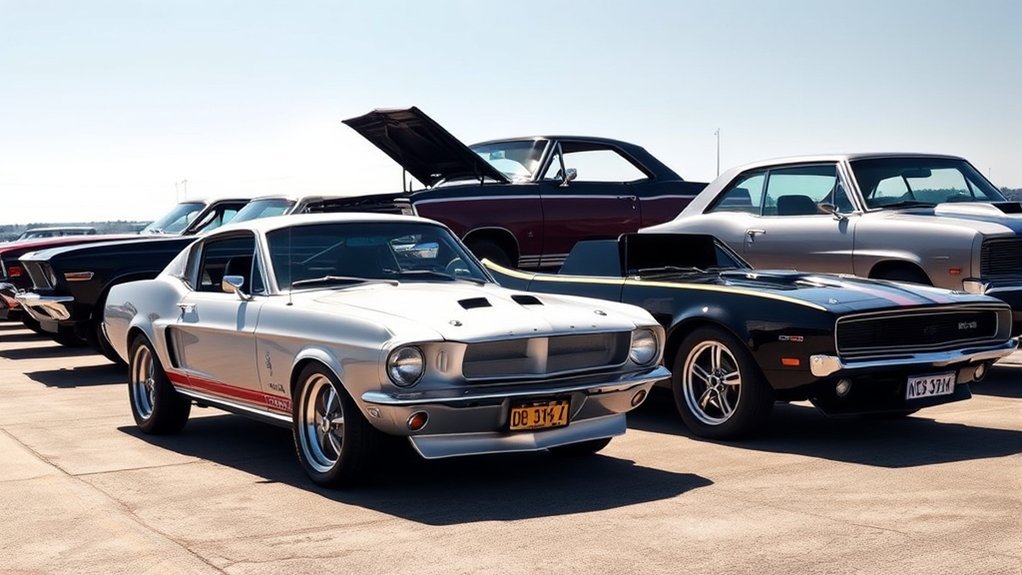
Horsepower alone does not show how one muscle car compares with another. A fair comparison must account for the rating method, vehicle weight, gearing, tires, transmission, aerodynamics, and test conditions.
- Horsepower standard: Golden-era SAE gross ratings are not directly comparable with modern SAE net ratings.
- Tire technology: Modern performance tires provide far more grip than period bias-ply tires.
- Transmission performance: Modern automatics can shift more quickly and offer more ratios than classic three-speed units.
- Launch control: Current engine and chassis computers can manage wheelspin and power delivery.
- Braking: Large disc brakes, anti-lock systems, and modern tires dramatically reduce stopping distances.
- Handling: Independent suspension designs, adaptive dampers, and improved chassis rigidity allow modern cars to corner more effectively.
- Safety and comfort: Airbags, crash structures, climate control, sound insulation, and driver-assistance systems add considerable weight but make high performance easier to use daily.
Representative classic factory ratings include:
- 1964 Pontiac GTO: 389-cubic-inch V8, 325 SAE gross horsepower with the standard four-barrel setup.
- 1968 Ford Mustang 428 Cobra Jet: 428-cubic-inch V8, 335 SAE gross horsepower.
- 1968 Dodge Charger R/T: 440-cubic-inch V8, 375 SAE gross horsepower.
- 1970 Chevrolet Chevelle SS 454 LS6: 454-cubic-inch V8, 450 SAE gross horsepower.
- 1971 Ford Mustang Boss 351: 351-cubic-inch V8, 330 SAE gross horsepower.
Period road-test times can be useful, but they should be treated as individual test results rather than permanent specifications. Weather, altitude, axle ratio, transmission, engine tune, tire condition, and driver technique could change a quarter-mile or 0-to-60-mph result substantially.
How to Verify a Classic Muscle Car’s Identity
High values and decades of repairs mean that badges and engine claims should never be accepted without documentation. An ordinary model may have been converted into a convincing tribute car, while a genuine factory performance model may no longer have its original engine.
Before treating a car as an authentic factory muscle model, check:
- VIN: Confirm that the code format and engine designation match the exact manufacturer and model year.
- Data plate or cowl tag: Review body style, assembly plant, paint, trim, and equipment codes where applicable.
- Build sheet or factory invoice: These can document the original engine, transmission, axle, packages, and options.
- Engine casting and stamping: Compare casting numbers, assembly dates, suffix codes, and partial VIN stamps with reliable factory references.
- Transmission and axle codes: A correct engine alone does not prove that the entire drivetrain is original.
- Model-year references: VIN and option-code formats vary, especially on cars built before the standardized 17-character VIN system began in 1981.
Pro Tip: Separate three different claims: an authentic factory performance model, a numbers-matching example, and a modified tribute car. Each can be enjoyable, but they do not have the same history or market value.
Warning: Many classic muscle cars lack anti-lock brakes, airbags, stability control, and modern crash protection. They may also have drum brakes, aged suspension parts, or unsuitable tires. Inspect the car carefully and learn its limits before using its performance.
Frequently Asked Questions
What is an example of a muscle car?
The 1964 Pontiac GTO is one of the clearest examples. It combined a midsize Pontiac Tempest LeMans body with a 389-cubic-inch V8, performance equipment, bold branding, and a price within reach of many new-car buyers.
How did muscle cars influence the automotive world?
They made factory performance a major sales tool and pushed manufacturers to compete through engine options, transmissions, suspension packages, styling, and motorsports. They also helped build a large aftermarket for restoration and performance parts.
What years are considered the muscle car era?
The classic golden age is usually placed from the mid-1960s through the early 1970s. The 1964 Pontiac GTO is a common starting point, while the ending is often placed between 1971 and 1973 as engine output, regulations, insurance costs, and fuel conditions changed.
How did cars revolutionize American life?
Cars expanded personal mobility, changed where people lived and worked, supported suburban growth, reshaped retail and tourism, and created large manufacturing and service industries. They also became tools of personal identity and social expression.
Is the Ford Mustang a muscle car or a pony car?
The Mustang is technically the original pony car. However, big-engine and high-performance versions such as the Cobra Jet, Boss, Mach 1, Shelby, GT, and Dark Horse are often grouped with muscle cars in broader popular usage.
Why did advertised horsepower fall in the early 1970s?
Output fell on many engines because of lower compression, emissions requirements, fuel changes, and different tuning. At the same time, the industry moved from optimistic SAE gross ratings to more realistic SAE net measurements, making the numerical decline appear even larger.
Conclusion
The muscle car era began as an affordable-performance movement, reached its best-known form during the 1960s and early 1970s, and then adapted to new fuel, emissions, safety, and market demands. The Rocket 88 helped establish the big-engine idea, the Pontiac GTO defined the classic formula, and models such as the Chevelle SS, Road Runner, Charger R/T, Mustang, and Camaro turned performance into a lasting part of American culture.
Modern technology has changed the details. A current performance car may use a naturally aspirated V8, a twin-turbocharged inline-six, or electric motors. Yet the central appeal remains familiar: distinctive styling, accessible production-car performance, and a direct connection between the driver and the machine.
Sources
- GM Heritage Collection: 1964 Pontiac GTO — GTO engine specifications, equipment, pricing, and historical role.
- GM Heritage Archive Vehicle Information Kits — original General Motors model-year specifications and historical documents.
- U.S. Environmental Protection Agency: Clean Air Act Requirements and History — federal emissions-law history.
- U.S. Energy Information Administration: Oil Timeline — the 1973 Arab oil embargo and its effects.
- Ford: 2026 Mustang — current Mustang lineup and Dark Horse specifications.
- Dodge: 2026 Charger — current gasoline and electric Charger configurations and performance ratings.







Leave a Reply