
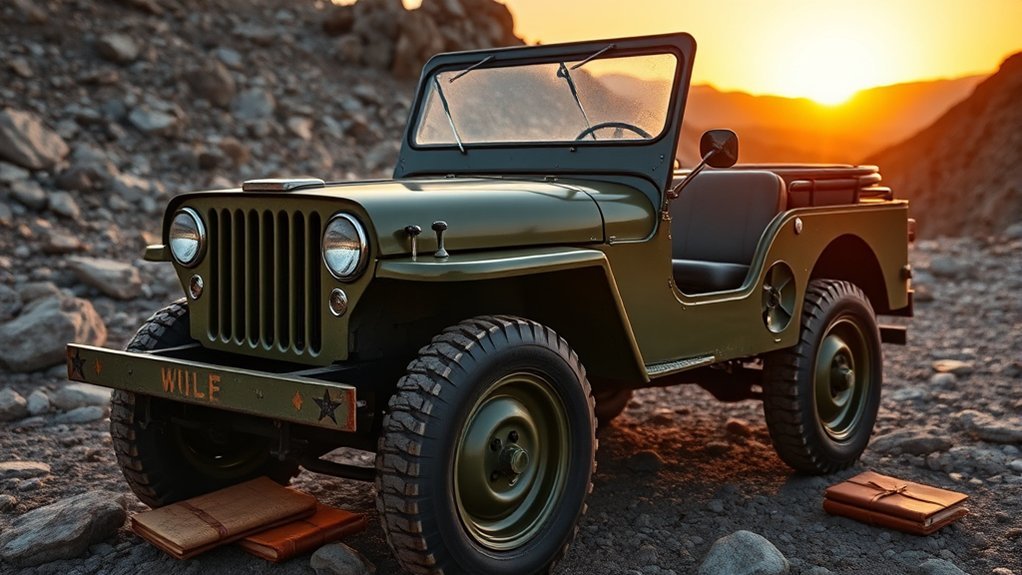
Classic Jeep trucks trace their pickup history to the Willys-Overland Truck introduced in 1947, not just to the better-known Gladiator of the 1960s. The lineage later expanded through the full-size Gladiator and J-Series, the compact Comanche, and the modern Gladiator. Each generation used different frames, engines, transmissions, four-wheel-drive systems, and model-identification methods.
Quick Answer
Classic Jeep pickups include the 1947–1965 Willys-Overland Truck, the 1963–1987 full-size Gladiator and J-Series, and the 1986–1992 Comanche. The Gladiator name returned for the 2020 model year. Because engines, axles, and four-wheel-drive systems changed often, buyers should verify each truck by its identification tags and factory records.
Key Takeaways
- Jeep pickup history begins with the 1947 Willys-Overland Truck, 16 years before the first Gladiator model year.
- The historic Gladiator and J-Series were full-size, body-on-frame trucks related to the Wagoneer, while the later Comanche used an XJ Cherokee-based uniframe design.
- T-14, T-15, and T-18 designations refer to manual transmissions; they are not transfer cases or automatic transmissions.
- Model-year specifications alone cannot confirm what remains in a truck after decades of engine, axle, grille, bed, and drivetrain swaps.
- Rust, frame condition, brakes, steering, fuel hoses, wiring, cooling, title history, and VIN or serial-number accuracy matter more than fresh paint.
Classic Jeep Truck Timeline at a Glance
Jeep’s pickup history includes overlapping names and model-year transitions. The table below separates the principal truck families and explains how they relate to one another.
| Model years | Truck family | Key distinction |
|---|---|---|
| 1947–1965 | Willys-Overland Truck | Jeep’s first postwar pickup line, offered in two- and four-wheel-drive configurations with several commercial body styles. |
| 1963–1971 | Gladiator | Full-size SJ-platform pickup related to the Wagoneer; early names included J-200 and J-300. |
| 1971–1987 | J-Series | The Gladiator name was dropped in 1971. J-10 and J-20 designations appeared for 1974, with several trim and weight-rating variations. |
| 1986–1992 | Comanche (MJ) | Compact XJ Cherokee-based pickup offered with short and long beds, two-wheel drive, and four-wheel drive. |
| 2020–present | Gladiator (JT) | Modern midsize pickup that revived the Gladiator name but is mechanically separate from the historic SJ truck. |
Note: Historical date ranges can overlap because vehicles were announced before their model year, old and new lines were sometimes sold at the same time, and Jeep changed model names separately from the underlying platform.
The Origins of Jeep Trucks: A Historical Perspective
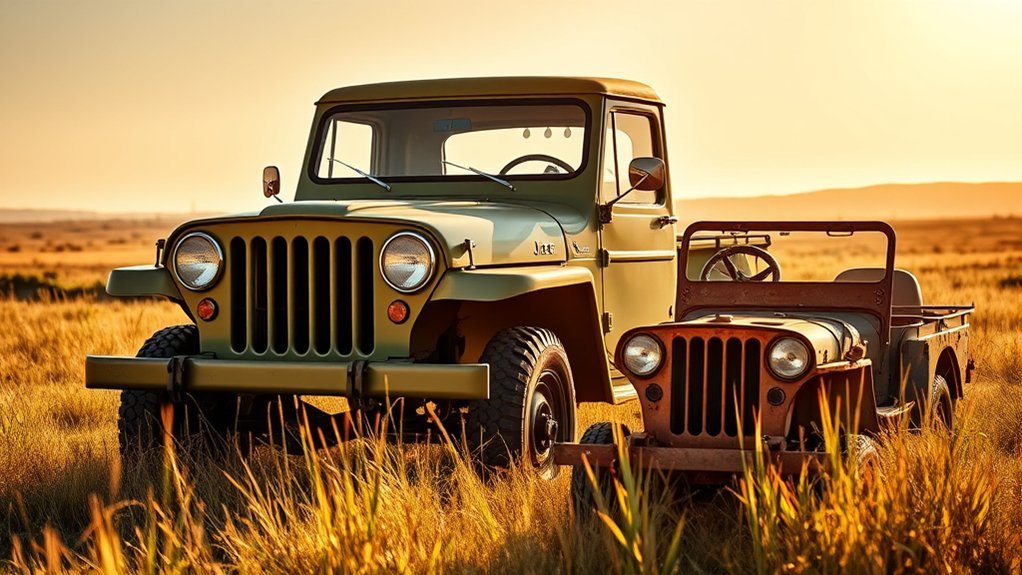
Jeep’s production pickup history began with the 1947 Willys-Overland Truck. The 118-inch-wheelbase line was marketed for farm, commercial, and utility work. Buyers could obtain two- or four-wheel drive and choose among pickup, stake-bed, chassis-cab, and bare-chassis configurations.
Early Willys trucks shared components with the Willys Wagon. Engine availability changed during the long production run and included four- and six-cylinder designs such as the Go-Devil, Super Hurricane, and later Tornado engines. Because production extended into the 1960s, the exact engine, transmission, axle, and electrical system must be checked by model year.
A new full-size generation arrived when Jeep introduced its J-line Gladiator in 1962 for the 1963 model year. According to Jeep’s official 1960s history, the Gladiator shared its SJ platform, front styling, and major powertrain architecture with the Wagoneer.
Jeep ownership also changed during this history. Willys-Overland became part of Kaiser, American Motors Corporation acquired Kaiser Jeep in 1970, and Chrysler acquired AMC in 1987. These transitions affected engine sourcing, transmission choices, trim, badging, parts numbering, and service documentation.
Key Generations of Jeep Pickup Trucks
Early Jeep Truck Models
The 1947–1965 Willys truck was simpler and narrower than the later full-size pickups. Its appeal today comes from its postwar styling, straightforward mechanical layout, and connection to Jeep’s early civilian utility vehicles.
These trucks were built for work rather than comfort. Surviving examples may have replacement beds, converted electrical systems, later engines, altered gearing, or drivetrain components borrowed from other Willys and Jeep vehicles. A correct-looking truck is not necessarily mechanically original.
Gladiator and J-Series Evolution
The first Gladiators were offered in 120-inch J-200 and 126-inch J-300 forms. Factory configurations included narrow Thriftside beds, wider Townside beds, chassis-cab models, stake beds, wreckers, and camper applications. Early four-wheel-drive versions commonly used a Dana 20 transfer case and Dana 44 axles.
In late 1965, Jeep renamed the J-200 and J-300 as the J-2000 and J-3000. Other designations, including J-4000 variants, appeared as Jeep expanded wheelbase and weight-rating choices. The Gladiator name was dropped in 1971, but the same basic SJ full-size truck family continued.
For 1974, the better-known J-10 and J-20 names appeared. Jeep lists the J-10 with a 119-inch wheelbase and the J-20 with a 131-inch wheelbase. Heavier trucks received stronger frames, brakes, hubs, springs, and axle combinations according to their gross vehicle weight ratings.
The J-Series lineup also produced recognizable appearance packages. The Honcho, Golden Eagle, 10-4, and later Laredo packages could include special paint, striping, wheels, interior materials, lighting, roll bars, or other equipment. Package content varied by year, so a decal set alone does not prove authenticity.
The Jeep Comanche Generation
The Jeep Comanche, also called the MJ, debuted for the 1986 model year and remained in production through 1992. It was based on the XJ Cherokee rather than the older full-size SJ platform.
Unlike the traditional body-on-frame Willys and J-Series trucks, the Comanche used a uniframe structure that integrated much of the cab and front body structure. It was available with short and long beds and in two- and four-wheel-drive configurations.
Early engine choices included a 2.5-liter four-cylinder, a 2.8-liter V6, and a limited-availability 2.1-liter turbodiesel. The fuel-injected 4.0-liter inline-six became available for 1987 and is one of the most sought-after Comanche powertrains.
The Modern Jeep Gladiator
The modern Gladiator returned for the 2020 model year. It revived a historic name after 32 years but did not continue the SJ chassis or vintage drivetrain. The JT is a modern midsize pickup related to the Wrangler, with contemporary safety systems, electronics, emissions controls, and removable body features.
The modern truck belongs in a complete Jeep pickup timeline, but it should not be used as a direct source for restoring or identifying a 1963–1987 Gladiator or J-Series vehicle.
What Engines Powered Classic Jeep Trucks?
Classic Jeep trucks used many engine families because the pickup line crossed several manufacturers and nearly five decades. Engine availability also depended on model year, weight rating, transmission, emissions package, and sales region.
| Generation | Common engine families | Collector notes |
|---|---|---|
| Willys-Overland Truck | Go-Devil four-cylinder, Super Hurricane six-cylinder, and later Tornado six-cylinder applications | Engine swaps are common. Confirm casting numbers, mounts, electrical voltage, cooling layout, and transmission compatibility. |
| Gladiator and J-Series | 230-cu-in Tornado inline-six, 327-cu-in Vigilante V8, AMC 232/258 inline-sixes, and AMC 304/360/401 V8s, depending on year | Published horsepower figures changed with engine tune and rating standards. Do not compare an early SAE-gross rating directly with a later net rating. |
| Comanche | 2.5-liter four-cylinder, early 2.8-liter V6, 2.1-liter turbodiesel, and 4.0-liter inline-six | The 4.0-liter inline-six is popular, but overall condition and the quality of previous repairs matter more than engine reputation alone. |
When evaluating an engine, look beyond its advertised displacement. Verify the casting number, carburetor or fuel-injection system, accessory layout, motor mounts, exhaust routing, and transmission pattern. A later engine can improve drivability, but a poorly executed swap can introduce cooling, wiring, fuel-delivery, and driveshaft problems.
Note: Engine size alone does not establish a matching-numbers vehicle. Compare the truck’s serial or VIN information, factory literature, casting dates, and documented ownership history.
Understanding Transmission Choices in Jeep Trucks
Jeep paired its trucks with several manual and automatic transmissions. Exact availability changed frequently, so the identification tag or casting on the installed unit is more reliable than a seller’s description.
Transmission Types Overview
Common manual-transmission families found across vintage Jeep trucks include the T-90 and T-98 in earlier applications and the T-14, T-15, and T-18 in later vehicles. Comanche models used several four- and five-speed manual transmissions according to engine and model year.
Automatic choices included the Turbo-Hydramatic used in some full-size Jeep trucks and later TorqueFlite applications. Comanche automatic transmissions also changed as its engine lineup evolved.
T-14, T-15, and T-18 designations identify manual transmissions. They should not be listed as automatic transmissions or transfer cases.
Manual Versus Automatic Options
| Consideration | Manual transmission | Automatic transmission |
|---|---|---|
| Driving feel | Provides direct gear selection and strong driver involvement. | Reduces clutch work in traffic and can provide smooth low-speed driving. |
| Inspection points | Clutch engagement, synchronizer operation, bearing noise, jumping out of gear, and linkage wear. | Fluid condition, delayed engagement, slipping, shift quality, overheating, leaks, and correct kickdown or throttle linkage. |
| Restoration concern | Correct bellhousing, input shaft, clutch linkage, and transfer-case adapter can be difficult to source. | Specialist rebuilding and correct transmission-to-transfer-case adapters can be expensive. |
| Best choice | Best for buyers who prefer direct control and are comfortable maintaining a clutch system. | Best for buyers who prioritize easier operation and verify that the unit shifts correctly when cold and hot. |
Performance Impact Considerations
Low-speed performance depends on the complete gear reduction created by the transmission’s first gear, transfer-case low range, axle ratio, tire diameter, and engine torque. A transmission should not be judged by its number of gears alone.
A truck with oversized tires and tall axle gearing may feel weak even with a healthy engine. Conversely, very low gearing can improve trail control while raising engine speed and noise on the highway. Check the axle tags and road-test the truck at the speeds you expect to use.
Which Transfer Cases Were Used in Jeep Trucks?
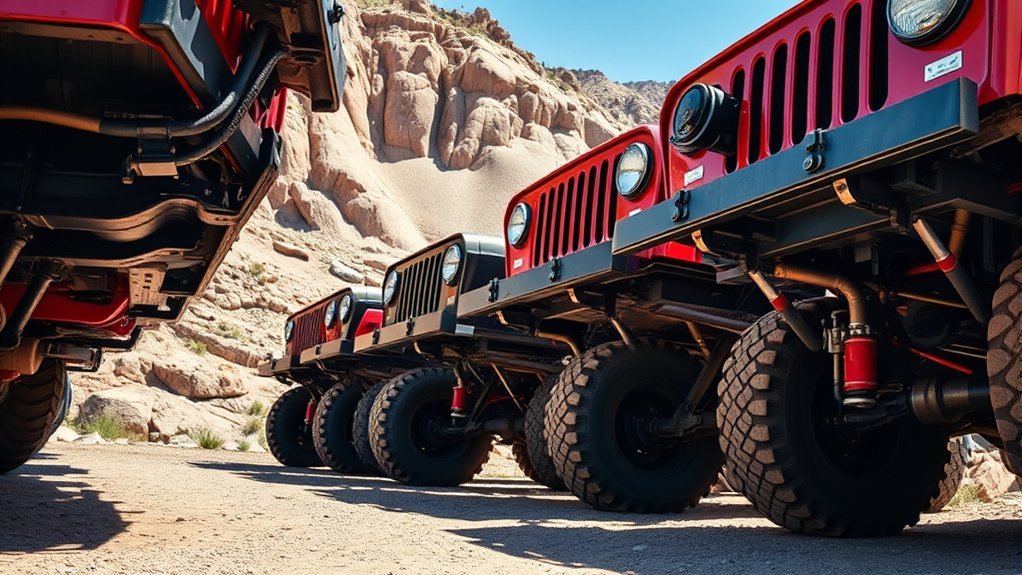
Early four-wheel-drive Gladiator pickups commonly used the gear-driven Dana 20 transfer case. Jeep lists a 2.03:1 low-range ratio for the Dana 20 in its early full-size truck history. Some early automatic applications used different drivetrain arrangements, so the transmission and transfer case must be identified together.
Quadra-Trac became an important full-time four-wheel-drive option in full-size Jeep vehicles during the 1970s. It used a center differential and allowed full-time operation, while an emergency-drive function could lock the system when additional traction was needed.
Later full-size trucks used several part-time and full-time New Process transfer-case configurations. The exact unit depended on model year, transmission, engine, and option package. It is unsafe to identify a later case only by assuming that every truck from a given year used the same model.
The Comanche offered Jeep systems such as part-time Command-Trac and, on selected configurations, Selec-Trac with full-time capability. Transfer-case availability changed during the 1986–1992 production period.
To identify an installed transfer case, inspect:
- The manufacturer tag or stamped model number
- The case material and housing shape
- The front and rear output locations
- The shifter pattern and linkage
- The transmission adapter and input-spline configuration
- Whether the front and rear axles match the transfer-case output arrangement
Pro Tip: Photograph the identification tag on the transmission, transfer case, and both axles before ordering seals, bearings, chains, adapters, or rebuild kits. A vehicle’s model year does not guarantee that its original drivetrain is still installed.
How Jeep Trucks’ Axles and Suspension Evolved
Axle and suspension design changed significantly between the Willys truck, full-size J-Series, and compact Comanche.
Early Gladiators commonly used Dana 44 front and rear axles. A tougher independent front suspension was available on certain half-ton models through 1965, but it was an early option rather than the standard design through the 1970s. Leaf-sprung solid axles became the familiar arrangement on most four-wheel-drive full-size Jeep trucks.
J-20 and higher-weight configurations could use heavier hubs, springs, brakes, frames, and rear axles than a lighter J-10. Wheel-lug count can provide a clue, but it does not prove the truck’s original weight rating because axle swaps are common.
The Comanche used a different layout based on the XJ Cherokee. Four-wheel-drive models used a linked, coil-sprung solid front axle, while leaf springs supported the rear axle and pickup bed. Its uniframe structure also requires different rust and collision-damage checks than a separate-frame J-Series truck.
A Jeep truck’s badge identifies the family, but its tags, castings, axle housings, and mounting details identify the drivetrain that is actually underneath it.
Interior Features and Trim Levels of Classic Jeep Trucks
Most early Jeep pickup interiors emphasized durability and easy service. Bench seats, painted metal surfaces, simple gauges, rubber floor coverings, and limited sound insulation were common.
Later full-size trucks offered more comfort and appearance equipment. Depending on year and trim, buyers could find carpeting, upgraded upholstery, air conditioning, power accessories, decorative steering wheels, additional gauges, and woodgrain or color-coordinated trim.
Recognizable J-Series packages included the Honcho, Golden Eagle, 10-4, and Laredo. Original trim can increase collector interest, but authentication requires more than decals. Check factory literature, paint layers, seat material, dashboard equipment, option codes, mounting holes, and period photographs.
The Comanche introduced a more modern cabin shared in part with the XJ Cherokee. Controls, seats, dashboard components, steering columns, and electrical systems differ sharply from those in the older full-size trucks.
Many surviving interiors have been restored or modified. Replacement seat covers, aftermarket gauges, modern stereos, altered wiring, later steering columns, and air-conditioning conversions may improve usability but can reduce originality.
How to Identify a Classic Jeep Truck Correctly
Start with the identification plate or VIN, but do not stop there. A complete identification process should compare documents, body details, frame or uniframe construction, drivetrain tags, and model-year literature.
- Pre-1981 trucks: Serial-number length and coding varied. Use the correct year’s factory service manual, parts catalog, owner documentation, and body or frame tags.
- 1981 and newer trucks: Use the 17-character VIN and the official NHTSA VIN Decoder where applicable.
- Title comparison: Make sure the title, registration, dashboard or body plate, and stamped identification locations agree.
- Model-year clues: Compare the grille, marker lights, dashboard, door hardware, bed design, wheelbase, and trim with factory literature.
- Drivetrain verification: Record engine castings, transmission tags, transfer-case tags, axle housings, axle ratios, and hub patterns.
Collectors use informal grille nicknames such as Rhino, razor, muscle, egg-crate, and pig-nose. These names are useful in conversation but are not substitutes for model-year documentation. Grilles and front clips can be exchanged between many SJ-platform vehicles.
Note: NHTSA’s modern decoder is most useful for standardized 1981-and-newer VINs. A failed decode does not automatically mean that an earlier truck’s shorter serial number is invalid.
Essential Tips for Buying Classic Jeep Trucks
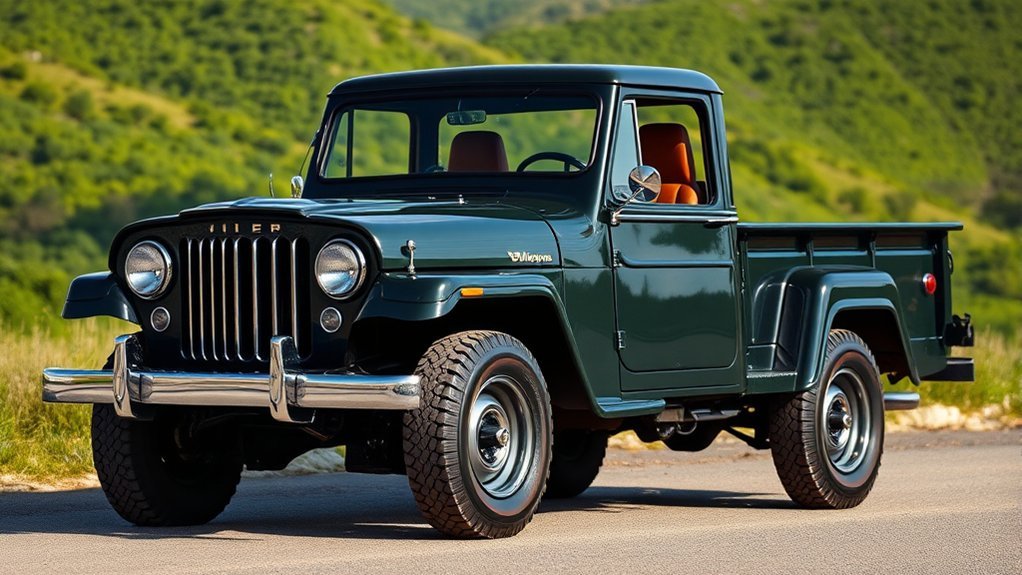
A classic Jeep truck can hide costly structural and mechanical problems beneath new paint, undercoating, or interior trim. Inspect the vehicle in daylight, begin with a cold engine, and arrange access to a lift whenever possible.
Warning: Severe frame or uniframe corrosion, cracked steering mounts, deteriorated brake lines, old tires, or leaking fuel hoses can make a vintage truck unsafe. Have structural and roadworthiness concerns evaluated by a qualified technician before driving or purchasing the vehicle.
| Inspection area | What to check | Why it matters |
|---|---|---|
| Frame or uniframe | Spring hangers, steering-box area, crossmembers, cab mounts, rear rails, collision repairs, patches, and fresh undercoating. | Structural repairs can cost more than mechanical work and may affect alignment and safety. |
| Body and bed | Floors, rockers, lower doors, windshield surround, drip rails, bed supports, wheel openings, seams, and body filler. | Cosmetic rust may conceal weakened supports or difficult-to-find replacement panels. |
| Engine and cooling | Cold starting, oil pressure, smoke, blow-by, coolant contamination, radiator condition, overheating, leaks, and fan clearance. | Cooling problems and neglected engines can turn a running project into a complete rebuild. |
| Transmission and clutch | Engagement when cold and hot, slipping, bearing noise, synchronizers, clutch chatter, linkage, and fluid leaks. | Correct replacement parts and adapters may be scarce or expensive. |
| Four-wheel drive | Transfer-case identification, linkage, range selection, vacuum controls where fitted, chain or bearing noise, driveshaft vibration, and matching axle ratios. | Mismatched ratios or a damaged case can cause binding and expensive drivetrain failure. |
| Steering and suspension | Steering play, frame movement, tie rods, ball joints, wheel bearings, spring bushings, shackles, shocks, and uneven tire wear. | Wear can make the truck wander, shake, brake unpredictably, or damage tires. |
| Brakes and tires | Steel and rubber lines, wheel cylinders or calipers, master cylinder, booster, parking brake, pull during braking, and tire date codes. | A tire with good tread can still be unsafe because of age, cracking, or internal deterioration. |
| Fuel and electrical systems | Brittle fuel hose, tank leaks, carburetor seepage, loose battery cables, melted connectors, unfused accessories, and twisted wire repairs. | Poor repairs can cause fires, charging failures, intermittent stalling, and difficult diagnostics. |
| Identity and documents | VIN or serial tags, title, registration, lien status, receipts, engine and axle identification, and restoration photographs. | Documentation affects registration, authenticity, resale value, and confidence in previous work. |
Cold-Start and Road-Test Checklist
- Confirm that the engine is cold before it is started.
- Watch for delayed oil pressure, heavy smoke, knocking, coolant leaks, or excessive crankcase pressure.
- Allow the engine to reach full operating temperature and confirm that it does not overheat.
- Test every forward gear and reverse, both cold and warm.
- Check clutch engagement or automatic-transmission engagement on a mild incline.
- Test high and low transfer-case ranges only in a suitable low-traction or approved setting.
- Listen for axle whine, universal-joint clunks, transfer-case noise, and driveshaft vibration.
- Confirm that the truck tracks straight and does not pull sharply while braking.
- Recheck the ground and underbody for fresh oil, coolant, transmission fluid, gear oil, or fuel leaks.
For applicable 1981-and-newer vehicles, use the official NHTSA recall lookup. A year, make, and model search can also provide general recall, investigation, complaint, and manufacturer-communication records.
Common Problems and Restoration Priorities
No single problem affects every classic Jeep truck, but age, work use, off-road use, and past modifications create predictable inspection priorities.
- Rust: Floors, cab mounts, bed supports, spring mounts, frame rails, rockers, windshield areas, and lower body seams deserve close inspection.
- Fluid leaks: Engines, manual transmissions, automatics, transfer cases, axles, steering boxes, and brake systems may all leak after decades of seal deterioration.
- Cooling problems: Clogged radiators, weak fan clutches, incorrect fans, corroded passages, and poorly designed engine swaps can cause overheating.
- Four-wheel-drive faults: Worn linkage, vacuum leaks, transfer-case chain wear, damaged hubs, mismatched axle gearing, and neglected lubricants can prevent correct operation.
- Steering wear: Loose steering boxes, worn tie rods, ball joints, bearings, and spring bushings can produce wandering or vibration.
- Electrical modifications: Added lights, stereos, ignition systems, winches, and engine swaps often leave undocumented wiring changes.
- Missing trim: Mechanical service parts may be obtainable, while correct grilles, tailgates, emblems, interior trim, and special-edition pieces can be difficult to replace.
Pro Tip: A complete, honest truck with worn paint is often a better restoration starting point than a disassembled project with boxes of unidentified parts. Missing trim, brackets, linkage, and model-specific hardware can consume more time than rebuilding familiar mechanical components.
Which Classic Jeep Truck Is the Best Fit?
| Truck family | Best suited to | Main tradeoff |
|---|---|---|
| Willys-Overland Truck | Collectors who value early postwar styling, mechanical simplicity, and historical character. | Slower road performance, fewer comfort features, and difficult body-part sourcing. |
| Gladiator or J-Series | Buyers wanting full-size presence, V8 availability, solid-axle capability, and distinctive styling. | Rust, fuel consumption, model-year complexity, and scarce trim or body panels. |
| Comanche | Buyers who prefer a compact truck, XJ-related components, and more modern road manners. | Uniframe corrosion, limited pickup-specific body parts, and damage from previous modifications. |
Purchase price should not be the only deciding factor. A more expensive truck with a sound structure, correct title, complete trim, and documented repairs may cost less overall than a cheap project requiring structural work and missing model-specific parts.
Frequently Asked Questions
What are the most popular Jeep truck restoration projects?
Popular projects include early Willys pickups, 1963–1971 Gladiators, J-10 and J-20 trucks, and 1986–1992 Comanches. Full-size Honcho, Golden Eagle, and other documented special-edition trucks also attract interest. The CJ series is collectible, but it is not a pickup-truck line.
How do classic Jeep trucks compare with other classic pickups?
Classic Jeep trucks stand out for their four-wheel-drive heritage, solid-axle capability, and uncommon styling. However, comparable Ford, Chevrolet, GMC, and Dodge trucks may have broader reproduction-body and trim support. Jeep buyers should weigh off-road character against rust, parts availability, road comfort, and restoration cost.
What are the most common problems in classic Jeep trucks?
Common inspection concerns include frame or uniframe corrosion, floor and bed rust, cooling problems, oil and gear-lubricant leaks, worn steering parts, aged brake and fuel lines, transfer-case faults, old tires, and undocumented electrical modifications.
Which classic Jeep truck engine is best?
There is no universal best engine. Early Willys engines appeal to originality-focused collectors, AMC V8s suit buyers seeking full-size performance, the 258 inline-six is valued for simplicity, and the Comanche’s 4.0-liter inline-six is popular for drivability. Condition and installation quality matter more than reputation alone.
Are parts easy to find for classic Jeep trucks?
Routine engine, brake, bearing, seal, and ignition parts may be available, especially for widely used AMC and Jeep components. Correct beds, tailgates, grilles, trim, interior pieces, special-edition parts, and uncommon drivetrain adapters can be much harder to locate.
How can I verify a classic Jeep truck’s model year and authenticity?
Compare the title with every identification tag, then check the wheelbase, body style, grille, dashboard, drivetrain tags, axle housings, engine castings, and factory literature. NHTSA’s VIN decoder can help with applicable 1981-and-newer vehicles, while earlier trucks require year-specific serial-number references.
Can a classic Jeep truck be used as a daily driver?
A properly restored truck can be driven regularly, but it will not provide the crash protection, braking performance, fuel economy, emissions controls, comfort, or parts availability of a modern vehicle. Brakes, steering, tires, lighting, cooling, seat belts, and fuel-system condition should be addressed first.
How did Jeep trucks influence off-road culture?
Jeep pickups combined cargo utility with factory four-wheel drive at a time when that combination was less common. Their use on farms, work sites, trails, expeditions, and recreational builds helped connect the Jeep name with practical off-road travel rather than passenger vehicles alone.
Where can I find Jeep truck enthusiast communities?
Look for clubs and forums dedicated to Willys vehicles, full-size Jeep models, or the Jeep Comanche rather than relying only on general Jeep groups. Model-specific communities are often the best sources for casting identification, factory literature, hard-to-find parts, and photographs of original trucks.
Conclusion
Classic Jeep trucks cover several distinct vehicle families rather than one continuous model. The 1947 Willys-Overland Truck established the pickup lineage, the 1963 Gladiator began the full-size SJ generation, the J-Series carried that platform into the 1980s, and the Comanche closed Jeep’s original pickup era in 1992.
The best truck is not necessarily the rarest trim or largest engine. A sound frame or uniframe, accurate identification, complete parts, safe brakes and steering, a healthy cooling system, and documented repairs create a better foundation than fresh paint over hidden corrosion. Verify the specific truck in front of you rather than relying only on its badge, advertised model year, or seller’s parts list.
Sources
- Jeep Brand: 1940s History — Willys-Overland Truck production dates, configurations, and early engine history.
- Jeep Brand: 1960s History — Gladiator introduction, wheelbases, bed configurations, Dana 20, Dana 44 axles, and early IFS availability.
- Jeep Brand: 1970s History — J-10 and J-20 specifications, full-size truck improvements, and special trim packages.
- Jeep Brand: 1980s History — Comanche model years, XJ relationship, uniframe construction, and bed configurations.
- Jeep Brand: 2020s History — Return of the modern Gladiator for the 2020 model year.
- National Highway Traffic Safety Administration VIN Decoder — Standardized VIN decoding and manufacturer-reported vehicle information for applicable vehicles.







Leave a Reply