
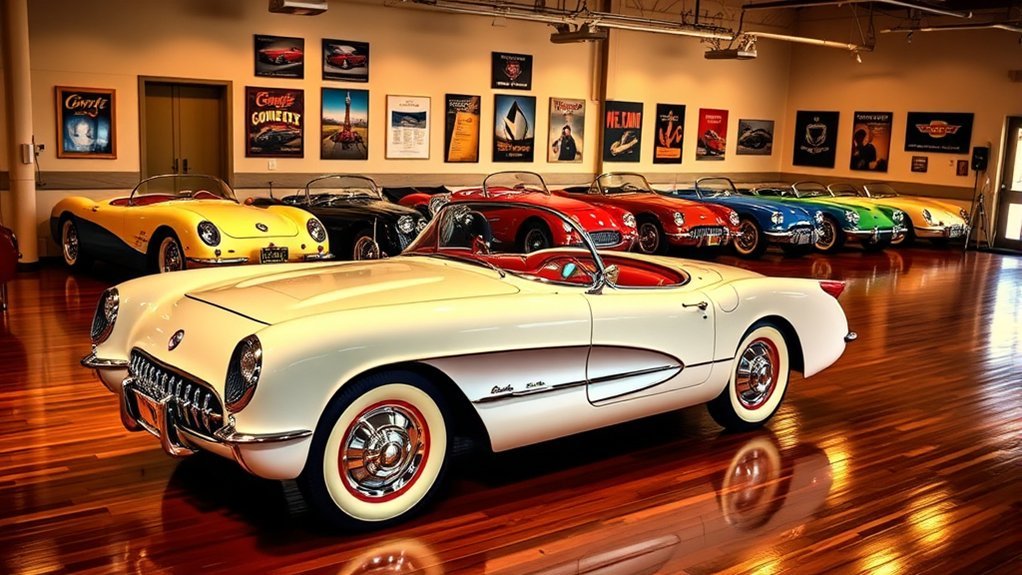
The Chevrolet Corvette has evolved from a hand-built 1953 roadster into a family of mid-engine sports cars with naturally aspirated, twin-turbocharged, and electrified powertrains. Its history spans eight generations, major changes in chassis design and engine technology, and more than seven decades of road and racing development.
Quick Answer
Corvette history began with a concept shown at the GM Motorama on January 17, 1953. Chevrolet built 300 production cars that year. Eight generations later, the Corvette has progressed from a 150-horsepower six-cylinder roadster to the mid-engine, 1,250-horsepower ZR1X and an expanding range of electrified performance models.
Key Takeaways
- The Corvette debuted at the 1953 GM Motorama, and only 300 production cars were built for its first model year.
- The small-block V8 arrived in 1955 and changed the Corvette from a stylish cruiser into a serious performance car.
- Eight generations—C1 through C8—have introduced advances such as fuel injection, independent rear suspension, rear transaxles, composite structures, and a mid-engine layout.
- The 2019 ZR1’s 755 hp was later surpassed by the 1,064-hp ZR1 and 1,250-hp electrified ZR1X.
- Chevrolet has confirmed new 2027 Stingray, Grand Sport, and Grand Sport X models, but it has not published a production date for a fully battery-electric Corvette.
The Birth of the Corvette: From Motorama Concept to Production Car
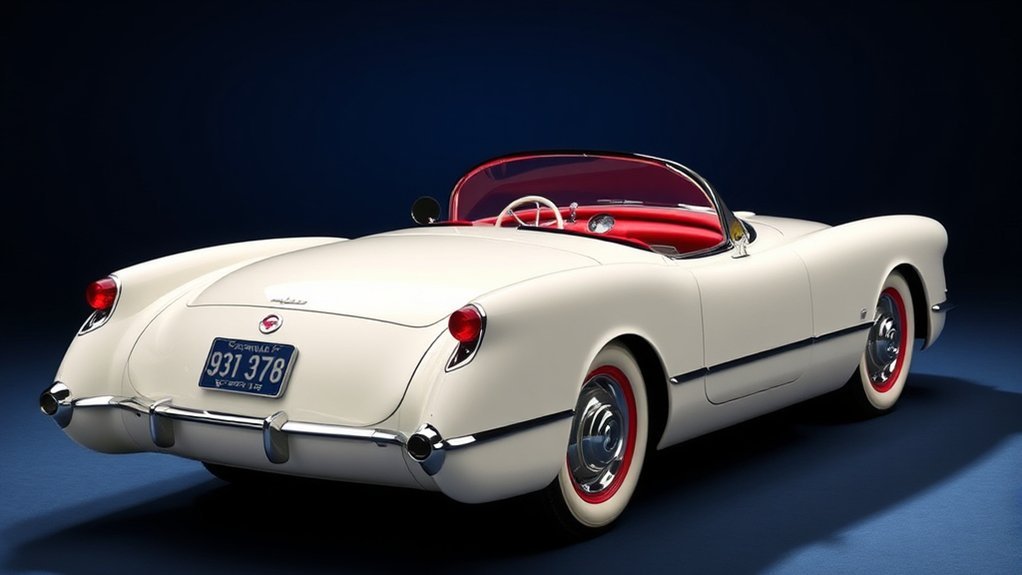
The Corvette made its public debut at the GM Motorama in New York City on January 17, 1953. The two-seat concept drew enough attention for General Motors to approve a limited production run.
Chevrolet built 300 Corvettes for the 1953 model year. All were Polo White roadsters with red interiors. Their fiberglass bodies were unusual at a time when most production cars used steel exterior panels.
The first Corvette looked fast, but its drivetrain was modest by later standards. Its 235-cubic-inch “Blue Flame” inline-six produced 150 hp and was paired with a two-speed Powerglide automatic transmission. The combination limited the car’s appeal among drivers who expected a sports car to offer stronger acceleration and a manual transmission.
The turning point came in 1955. Chevrolet offered its new 265-cubic-inch, or 4.3-liter, small-block V8 with up to 195 hp. A three-speed manual also became available. Fuel injection followed in 1957, and the highest-output 283-cubic-inch engine was rated at 283 hp—an attention-grabbing one horsepower per cubic inch.
The first generation continued to improve through 1962. Changes included stronger brakes, revised styling, more powerful engines, and better road manners. Those improvements helped the Corvette survive its uncertain start and established the performance formula that later generations would build upon.
Corvette History by Generation: C1 Through C8
Corvette generations are identified with the letter “C” followed by a number. The sequence is informal but widely accepted by Chevrolet, owners, collectors, and the automotive industry.
| Generation | Model Years | Defining Developments |
|---|---|---|
| C1 | 1953–1962 | Fiberglass body, inline-six engine, small-block V8 from 1955, and optional fuel injection from 1957. |
| C2 | 1963–1967 | Sting Ray name, independent rear suspension, 1963 split-window coupe, Z06 package, four-wheel disc brakes, and big-block engines. |
| C3 | 1968–1982 | Long-running curving body design, removable roof panels, early high-output LT-1 and big-block options, and later emissions-era efficiency changes. |
| C4 | 1984–1996 | New chassis, digital instruments, improved aerodynamics, modern fuel injection, and the 1990–1995 ZR-1. |
| C5 | 1997–2004 | LS1 V8, rear-mounted transaxle for improved weight distribution, stronger hydroformed frame, and the return of the Z06 in 2001. |
| C6 | 2005–2013 | Exposed headlamps, 400-hp base engine at launch, aluminum-chassis Z06, and the 638-hp supercharged ZR1. |
| C7 | 2014–2019 | Return of the Stingray name, direct injection, seven-speed manual transmission, 650-hp Z06, and 755-hp ZR1. |
| C8 | 2020–present | First production mid-engine Corvette, eight-speed dual-clutch transmission, flat-plane-crank Z06, electrified E-Ray, twin-turbo ZR1, and eAWD ZR1X. |
Note: Chevrolet did not sell a regular-production 1983 Corvette to the public. Development and production delays pushed the redesigned C4 to the 1984 model year, creating the only missing model year in Corvette’s continuous history since 1953.
Major Corvette Design and Engineering Changes
Fiberglass and Composite Bodywork
The first Corvette used a fiberglass body partly because the material allowed Chevrolet to build low-volume shapes without investing in costly steel-stamping tools. Later generations continued using fiberglass-based and other composite panels. Modern high-performance models also use carbon fiber in selected body, chassis, wheel, and aerodynamic components.
Independent Rear Suspension
The 1963 C2 introduced an independent rear suspension that allowed each rear wheel to react more independently to bumps and cornering forces. This was one of the most important changes in the Corvette’s development from a powerful American roadster into a more balanced sports car.
Rear Transaxle Layout
The C5 moved the transmission to the rear of the car and connected it to the front-mounted engine with a rigid torque tube. The arrangement improved weight distribution and became a foundation for the C5, C6, and C7.
Mid-Engine C8 Layout
The C8 moved the engine behind the passenger compartment. The layout placed more weight over the driven rear wheels and gave engineers greater freedom to improve acceleration, cooling, aerodynamics, and high-speed stability. It also ended the availability of a traditional manual transmission; C8 models use an eight-speed dual-clutch transmission.
Key Corvette Performance Milestones
Horsepower figures from different eras are not always directly comparable. Before the early 1970s, American manufacturers commonly published SAE gross horsepower measured under laboratory conditions without the full accessory and exhaust load used for later SAE net ratings.
| Model Year | Model or Engine | Milestone |
|---|---|---|
| 1953 | Blue Flame inline-six | 150 hp in the first production Corvette. |
| 1955 | 265-cu-in small-block V8 | Up to 195 hp and the beginning of the Corvette’s long V8 tradition. |
| 1957 | Fuel-injected 283 V8 | Top version rated at 283 hp from 283 cubic inches. |
| 1970 | LT-1 350 V8 | Rated at 370 SAE gross hp. |
| 1990 | C4 ZR-1 | Its 32-valve, Lotus-developed LT5 helped restore Corvette’s world-class performance image. |
| 2009 | C6 ZR1 | Supercharged LS9 V8 rated at 638 hp. |
| 2019 | C7 ZR1 | Supercharged LT5 V8 rated at 755 hp. |
| 2023 | C8 Z06 | Naturally aspirated 5.5-liter flat-plane-crank LT6 rated at 670 hp. |
| 2024 | E-Ray | First production electrified and all-wheel-drive Corvette, with 655 combined hp. |
| 2025 | ZR1 | Twin-turbo 5.5-liter LT7 V8 rated at 1,064 hp. |
| 2026 | ZR1X | LT7 V8 and front electric motor produce 1,250 combined hp with electrified all-wheel drive. |
The Corvette progressed from 150 horsepower in 1953 to 1,250 combined horsepower in the 2026 ZR1X—more than eight times the output of the original car.
The Corvette’s Racing and Cultural Legacy
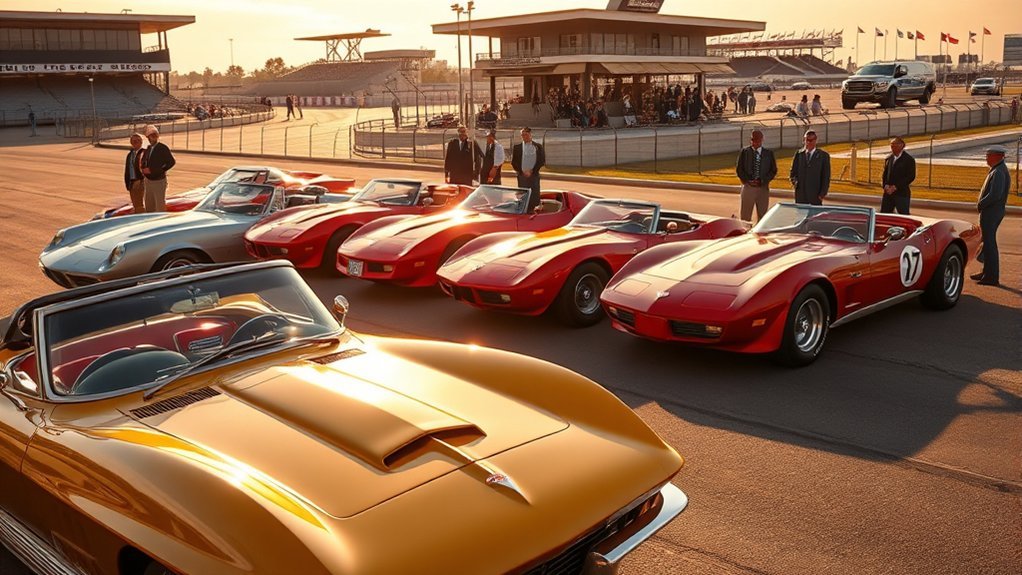
Early Competition and Le Mans
Competition helped reshape the Corvette during the 1950s. Engineer Zora Arkus-Duntov pushed for stronger engines, improved handling, and racing-focused development. Corvette made its Le Mans debut in 1960, where a privately entered car finished first in its class.
The 1963 Z06 package gave competition-minded buyers a larger fuel tank, stronger brakes, firmer suspension components, and other track-oriented equipment. Chevrolet also developed five lightweight 1963 Grand Sport race cars before corporate restrictions ended the planned production program.
Modern Corvette Racing
Modern factory-backed competition became closely associated with dedicated race cars rather than showroom models. The C5-R earned major victories at Daytona, Sebring, and Le Mans. It was followed by the C6.R, C7.R, and C8.R.
Chevrolet’s current Z06 GT3.R is a track-only GT3 race car based on the architecture and 5.5-liter engine family of the road-going C8 Z06. Customer teams can compete with it in professional and amateur GT championships around the world.
Note: Names such as Z06 and ZR1 appear on high-performance road cars, but Chevrolet’s professional race cars use separate designations such as C6.R, C7.R, C8.R, and Z06 GT3.R.
Corvette in Popular Culture
The Corvette became a recognizable part of American television, film, music, advertising, and toy culture. Early C1 models appeared prominently in the television series Route 66, which ran from 1960 through 1964. Later generations appeared in productions including Corvette Summer, Captain America: The Winter Soldier, and Transformers: Rise of the Beasts.
Its cultural position also comes from accessibility relative to many exotic sports cars. Although rare editions can become expensive collectibles, Chevrolet has continued to offer a regular-production Stingray alongside more specialized variants.
The Corvette Lineup and Confirmed Future Developments
As of July 2026, Chevrolet lists five current Corvette models: Stingray, E-Ray, Z06, ZR1, and ZR1X.
- Stingray: The core rear-wheel-drive C8, designed for daily road use and performance driving.
- E-Ray: A gas-electric hybrid that combines a rear-mounted V8 with a front electric motor and all-wheel drive.
- Z06: A track-focused model powered by a 670-hp, naturally aspirated flat-plane-crank V8.
- ZR1: A rear-wheel-drive model powered by a 1,064-hp twin-turbocharged LT7 V8.
- ZR1X: An electrified all-wheel-drive model combining the LT7 V8 with a 186-hp front motor for 1,250 combined hp.
Announced 2027 Corvette Models
In March 2026, Chevrolet announced another major C8 update. The 2027 Stingray and Grand Sport receive a new naturally aspirated 6.7-liter LS6 V8 producing 535 hp and 520 lb-ft of torque.
The rear-wheel-drive Grand Sport combines the LS6 with a wide body and available road- or track-focused performance packages. The Grand Sport X adds a front electric motor and electrified all-wheel drive, raising combined output to 721 hp.
These developments show that Chevrolet is pursuing more than one performance path. Naturally aspirated V8 models remain in the lineup, while E-Ray, Grand Sport X, and ZR1X use electric assistance to improve acceleration and all-wheel-drive traction.
Note: Chevrolet’s official materials confirm several electrified Corvettes, but they do not provide a production date for a fully battery-electric Corvette. Reports that assign such a model a definite release year should be treated as speculation until Chevrolet announces it.
Frequently Asked Questions
When was the first Chevrolet Corvette introduced?
The Corvette concept debuted at the GM Motorama in New York City on January 17, 1953. Chevrolet produced 300 cars for the 1953 model year, all finished in Polo White with red interiors.
Why was there no regular-production 1983 Corvette?
Chevrolet planned to introduce the redesigned C4 for 1983, but development, tooling, and production delays pushed the public launch to the 1984 model year. No regular-production 1983 Corvette was sold to customers.
What was the first V8-powered Corvette?
The 1955 Corvette was the first to offer Chevrolet’s 265-cubic-inch small-block V8. It produced up to 195 hp and was a major improvement over the original six-cylinder drivetrain.
Which Corvette was the first production mid-engine model?
The 2020 C8 Stingray was the first production Corvette with its engine mounted behind the passenger compartment. Chevrolet had tested several mid-engine concepts before then, but none reached regular production.
Is the Corvette E-Ray a fully electric car?
No. E-Ray is a gas-electric hybrid. A 6.2-liter V8 drives the rear wheels, while an electric motor drives the front wheels. The combination provides all-wheel drive and 655 combined horsepower.
What is the most powerful production Corvette?
As of July 2026, the ZR1X is the most powerful production Corvette. Its twin-turbocharged LT7 V8 and front electric motor produce 1,250 combined horsepower through an electrified all-wheel-drive system.
How has Corvette ownership changed over time?
The Corvette began as a low-volume American roadster and later attracted street drivers, racers, collectors, restorers, and performance-car buyers. The community now spans all eight generations, from carefully preserved C1 models to owners who use C8 variants for commuting, touring, or track events.
Do Corvettes hold their value?
Value depends on generation, condition, originality, documentation, mileage, options, and production volume. Rare models such as early fuel-injected cars, split-window coupes, original Grand Sports, and limited high-performance editions may command strong collector prices. Ordinary or heavily modified examples can depreciate like other used performance cars.
Where can Corvette owners find clubs and historical resources?
Owners can connect through local Corvette clubs, national owners’ organizations, model-specific communities, and restoration groups. The National Corvette Museum in Bowling Green, Kentucky, is a major source for exhibits, archives, historical programs, and preservation information, although it is a museum rather than an owners’ club.
Conclusion
The Corvette’s history is defined by repeated reinvention. It began as a low-volume fiberglass roadster, gained credibility through the small-block V8 and racing, adopted increasingly advanced chassis and engine technology, and became a mid-engine sports car with the C8.
Its direction is no longer limited to one type of powertrain. Chevrolet continues to develop naturally aspirated V8 models while using turbocharging and electric front-drive systems in its highest-performance variants. From the 150-hp 1953 roadster to the 1,250-hp ZR1X and announced 2027 Grand Sport models, the Corvette remains a changing—but recognizable—part of American performance-car history.
Sources
- Chevrolet Corvette Legacy — generation dates, first-year production, major engineering milestones, racing history, and cultural appearances.
- Chevrolet Corvette Lineup — current Stingray, E-Ray, Z06, ZR1, and ZR1X lineup information.
- Chevrolet 2026 Corvette ZR1X Announcement — LT7 engine, electric motor, all-wheel drive, and 1,250-hp combined output.
- Chevrolet 2027 Corvette Grand Sport Announcement — new LS6 V8, Stingray update, Grand Sport, and Grand Sport X specifications.
- Chevrolet Corvette Racing — modern race program and Z06 GT3.R information.
- National Corvette Museum: The One and Only 1983 Corvette — explanation of the missing public 1983 model year.







Leave a Reply